
01 / ANTHROPIC / THE PROPOSED IPO / OCTOBER 27, 2026 You use Claude. |  |
AI is shaping the future. Before investing, look twice at the business, the price, and what you actually own.
|
A USEFUL PRODUCT IS THE START OF THE INVESTIGATION.
01 THE BUSINESS Who pays? | 02 THE ECONOMICS Who earns? | 03 THE SHARES What price? |
HOW / WHO / WHAT / WHEN
Imagine a professional finishing a demanding report with Claude, then seeing the headline: its developer wants to go public. The product has already earned a place in the working day. Should its shares earn a place in the portfolio?
That is a hypothetical scene. The catalyst is real: Anthropic announced its public IPO filing on October 26. It proposes the Nasdaq symbol ANT. The share count and offering price range remain undetermined.
This opens an unusually revealing investment story. Rapid revenue growth sits beside a vast reported loss. Earlier financing agreements complicate the numbers. Infrastructure partners may benefit even while the model developer keeps investing.
Our position today: investigate closely and withhold a buy recommendation. AI can transform business while investors still need to establish who captures the value, what ownership they receive, and how much they should pay.
Before you sign, subscribe, or buy — look twice.
Research cutoff: October 27, 2026, before the U.S. regular session. Proposed offering; no public trading availability is assumed. All dollar figures are U.S. dollars. Editorial analysis, not a statement of an existing holding.
02 / THE BUSINESS / HOW AI EARNS REVENUE The future needs |  |
An AI model becomes a business when customers keep paying for work it helps them complete.
$16.29B H1 2026 revenue | $1.16B H1 2025 revenue | ~14× Revenue multiple / same period |
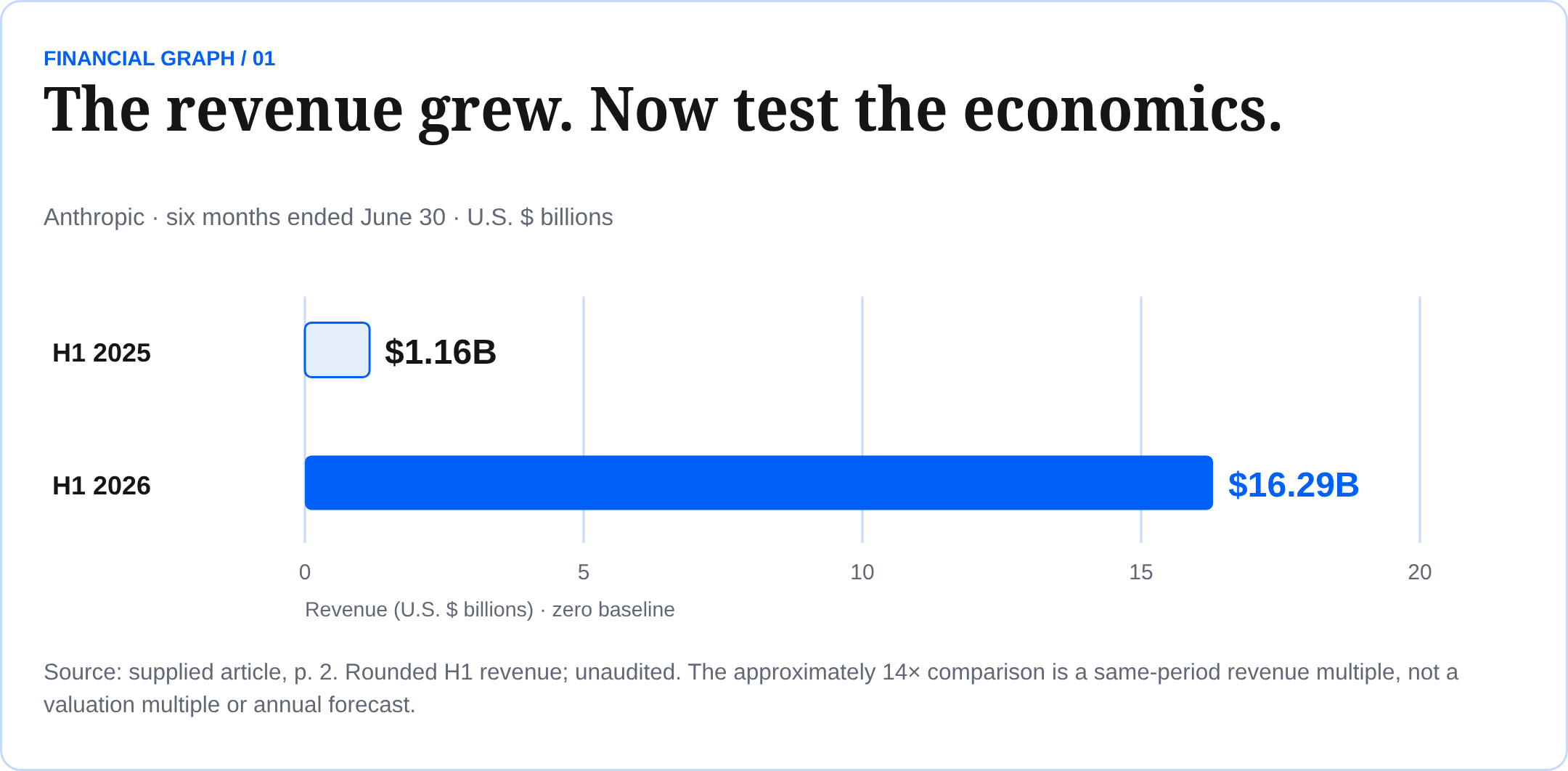
Useful work, repeat spending.
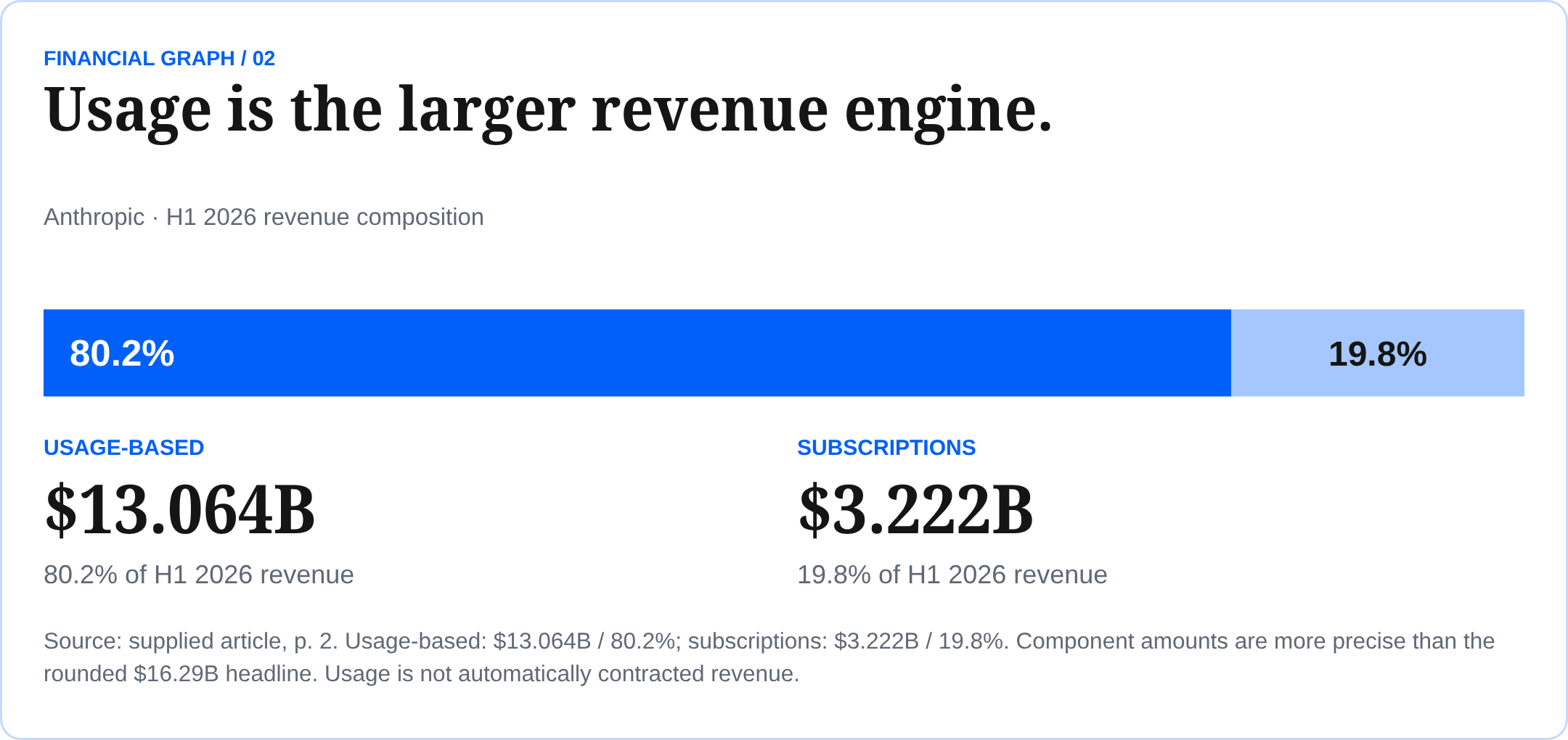
Anthropic sells access to Claude through usage-based pricing and subscriptions. Usage fees depend on the model and the amount processed; tokens are units used to meter that activity. Subscription plans provide a defined level of access and capabilities.
Customers can purchase directly or through cloud marketplaces. Higher use can increase revenue, but it also requires computing capacity. The commercial test is whether customers receive enough value to keep using and paying for the service.
Our interpretation: watch repeat spending and customer economics. Durable work matters more than experimentation.
Who keeps the value?
An application developer may earn from its customers. A model provider charges for intelligence. Cloud operators, chip suppliers and infrastructure owners charge for the capacity behind it. These businesses have different costs and bargaining power.
Adoption alone does not establish which layer earns the strongest return. Competition can reduce prices while rising usage increases infrastructure demand. Better efficiency can improve economics, but those gains must appear in the financial evidence.
AI is a technology thesis. An investment needs a company-specific explanation of revenue, costs, cash and the price paid for ownership.
Six months ended June 30; interim figures unaudited. Revenue shares and ~14x comparison are our calculations from reported figures. Annualizing a recent period is not a forecast. Usage revenue is not automatically long-term contracted revenue.
03 / THE ACCOUNTS / READ BEYOND THE HEADLINE An $80.7 billion loss. |  |
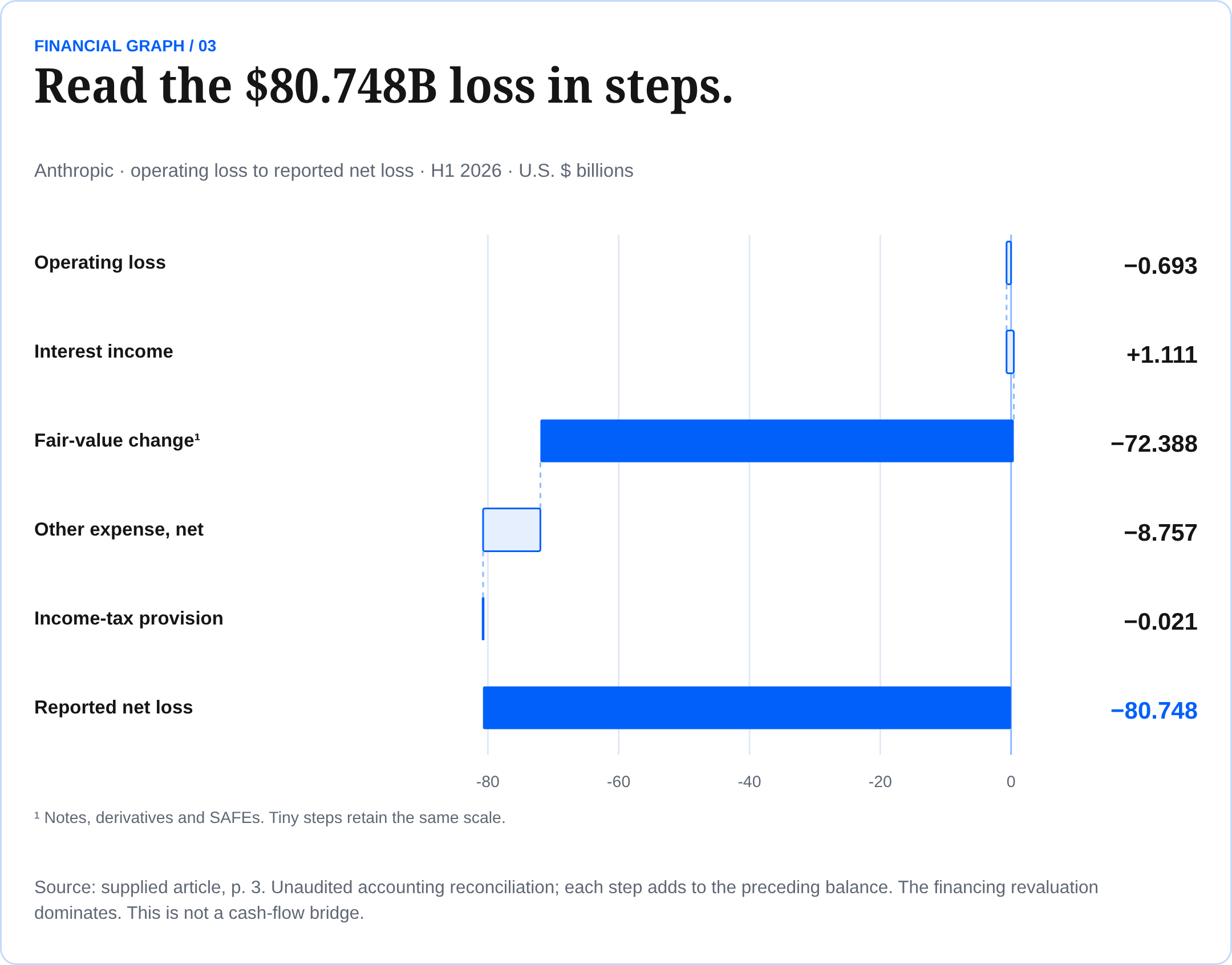
A financing revaluation dominates the net loss. The operating result and cash flow tell different parts of the story.
H1 2026 / USD billions | Reported amount |
|---|---|
Operating loss | −0.693 |
Interest income | +1.111 |
Fair-value change: notes, derivatives and SAFEs | −72.388 |
Other expense, net | −8.757 |
Income-tax provision | −0.021 |
Reported net loss | −80.748 |
A rising valuation, an expense.
Earlier investors supplied financing through instruments that can convert into shares. As the estimated value of those claims rises, remeasurement can create an expense for the issuer. Anthropic attributes the large charge primarily to its higher enterprise valuation.
Simplified hypothetical example: a claim first valued at $1 billion is later worth $4 billion. If remeasurement applies, the issuer records a $3 billion loss without paying out $3 billion at that moment.
Noncash still has consequences.
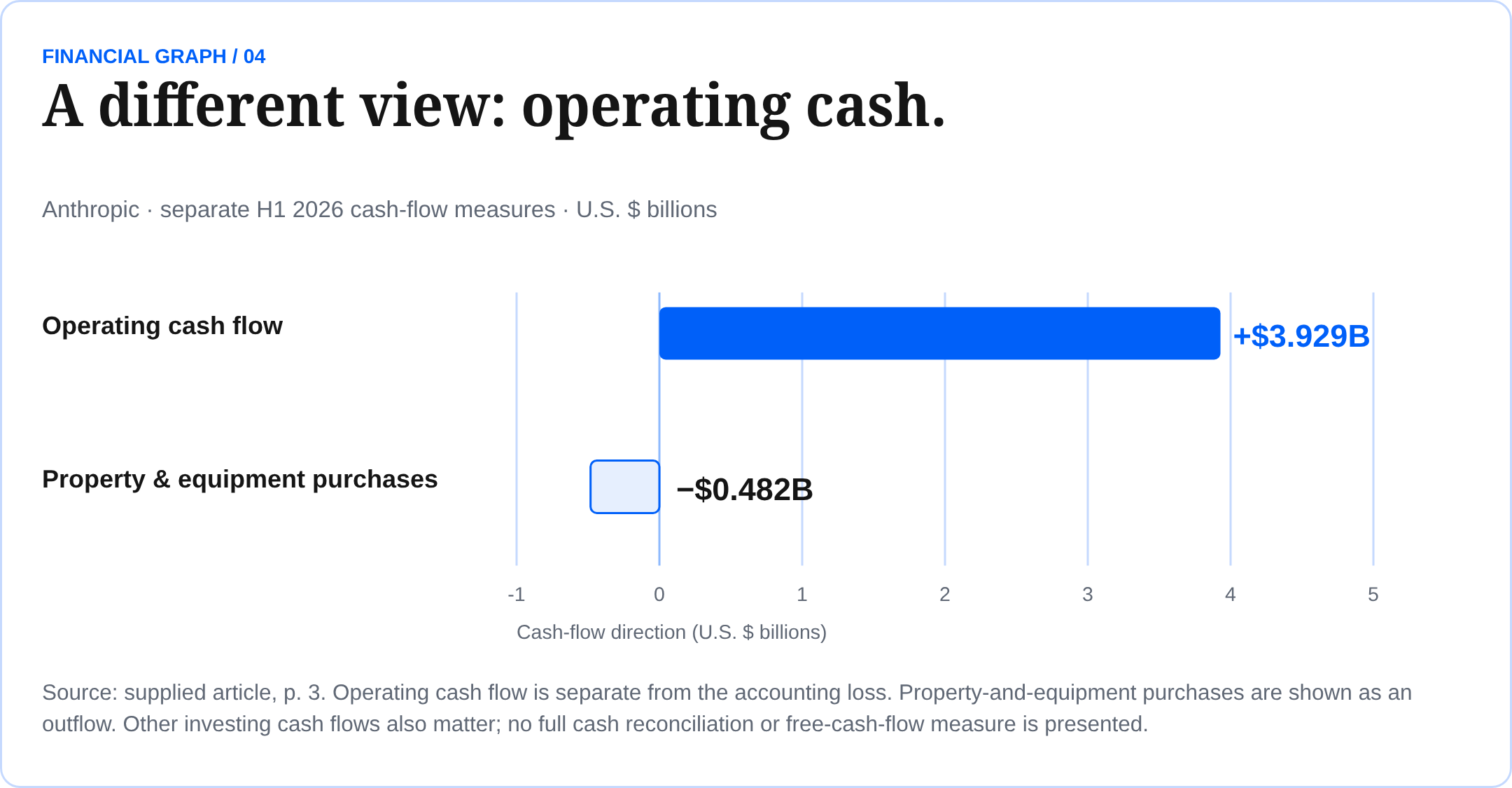
Those claims can affect future ownership. The charge is not meaningless, and removing it does not turn the remaining loss into cash burn. Positive operating cash flow also needs assessment alongside payment timing and infrastructure investment.
The charge itself is not evidence of tax fraud. Shareholder accounts and tax returns follow different rules; an accounting expense is not automatically deductible. Our review does not establish the tax treatment of these instruments.
H1 2026 unaudited; all bridge entries reconcile to the reported net loss. SAFE: simple agreement for future equity. Property-and-equipment purchases were $0.482B; other investing cash flows also matter. This is not a full cash-flow bridge.
S-1 / financial statements + MD&A · IRS / book-to-tax differences
|
04 / THE INVESTMENT / PRICE AND OWNERSHIP A compelling future. |  |
The business can succeed and the shares can still disappoint if the purchase price assumes too much.
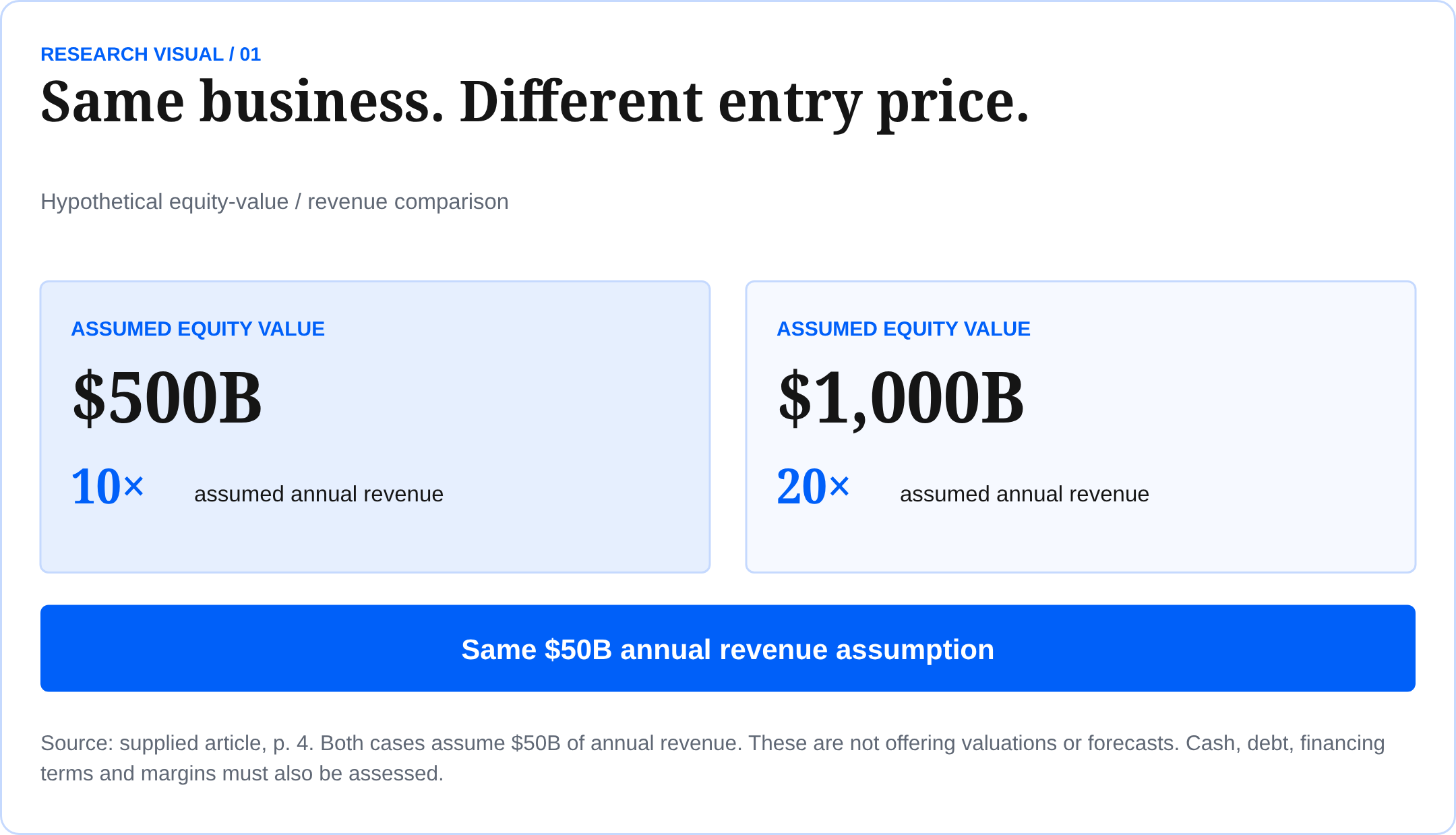
Illustration only: both cases assume $50B annual revenue. These are not offering valuations or forecasts. Equity value / revenue is a rough comparison; cash, debt, financing terms and margins must also be assessed.
What would earn a buy?
The positive thesis is credible as a question: can Claude become embedded in valuable workflows, retain customers and grow revenue faster than the cost of serving them? If so, improving economics could support a valuable business.
A recommendation still needs a defensible entry valuation. Calculate the fully diluted share count, including financing conversions, options and equity awards. A low-looking share price says little without knowing how many shares and claims exist.
We would look for repeat customer spending, improving cash conversion and funding sufficient for planned obligations. Growth must be evaluated against the capital required to deliver it.
Read what ownership means.
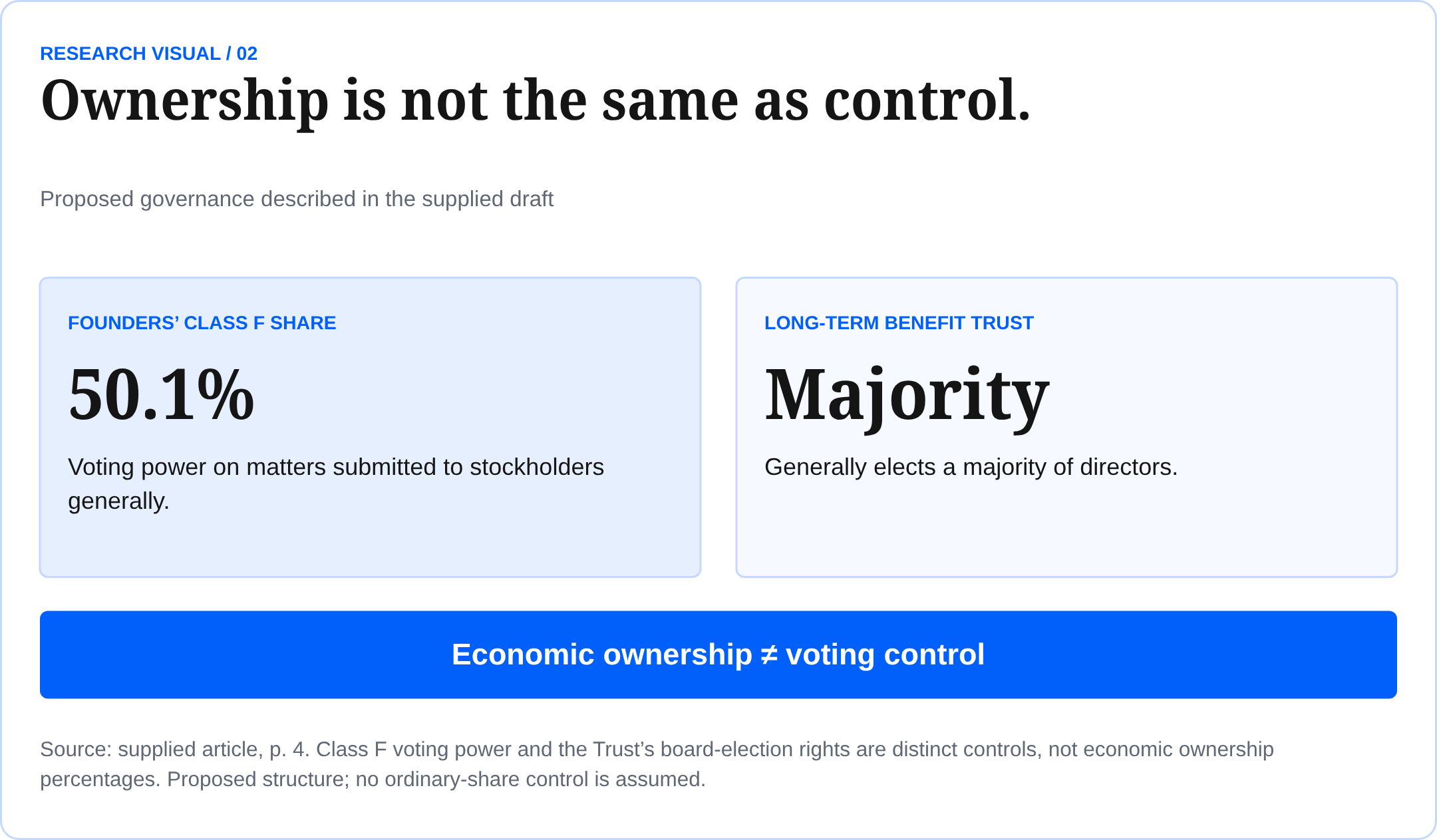
The proposed structure gives the founders' Class F share 50.1% of voting power on matters submitted to stockholders generally. Separately, the Long-Term Benefit Trust generally elects a majority of directors. Economic ownership and control are distinct.
Anthropic is a public benefit corporation. Its governance balances shareholder financial interests with its stated public benefit purpose. Investors should understand that mandate rather than assume ordinary shareholders set the direction.
Our decision today: wait for assessable offering terms. Revisit when the price, ownership rights and financial evidence support a reasoned long-term return case.
Editorial scenarios and assessment, October 27, 2026. No price target or return forecast. The example holds revenue constant to isolate entry-price differences; revenue alone does not determine fair value.
S-1 / capitalization, dilution + governance · Offering status
05 / FIVE BUSINESSES TO RESEARCH One AI ecosystem. |  |
These companies have different roles, economics and valuations. None is an automatic buy or a substitute for owning Anthropic.
ANT* / ANTHROPIC
Model developer
IPO filing opens the accounts; proposed listing.
Watch: offer price, dilution and cash economics.
AMZN / AMAZON
Investor + cloud provider
AWS supplies compute; Amazon holds financing claims.
Watch: cloud returns, capital needs and conversion.
GOOGL / GOOG / ALPHABET
Investor + cloud competitor
Google is an investor and a compute provider.
Watch: cloud economics and AI competition.
NVDA / NVIDIA
AI computing hardware
Anthropic identifies Nvidia GPUs in its compute mix.
Watch: durable demand, mix and customer returns.
AVGO / BROADCOM
Accelerators + networking
Oct. 26: $63B financing structure announced for capacity.
Watch: delivery from 2027 and lease execution.
Who benefits before the final profit?
Cloud operators and hardware suppliers can earn revenue as AI capacity is deployed. Yet that spending ultimately needs customers who can pay for useful work. Trace both sides: demand for infrastructure and the economics of the businesses buying it. A supplier's large order is evidence to examine, not proof that its shares are attractively priced.
*ANT is proposed; a completed listing is not assumed. Research candidates, not recommendations. The Broadcom announcement describes committed financing through an SPV for equipment leased to Anthropic; it is not $63B of recognized revenue.
S-1 / compute partners + financing · Broadcom / financing announcement
06 / OUR POSITION / LOOK TWICE BEFORE COMMITTING Investigate now. |  |
AI is shaping the future. How, who, what and when still decide whether an investment earns its place.
Following closely.
Withholding a buy recommendation.
What could change our view?
A defined offer price and fully diluted ownership would let us calculate the valuation. Durable customer spending, improving cash economics and adequate funding would strengthen the business case. The price must leave room for a reasonable outcome.
We would stay on the sidelines if the valuation demands flawless execution, financing obscures the ownership being purchased, or future spending outpaces a credible funding plan.
Patience is a decision.
A company does not need to be fraudulent to be an unattractive investment at a particular price. Nor does an unusual accounting loss settle its commercial prospects. Read the contracts, follow the cash and assess the shares.
Before you sign, subscribe to an offering or place an order, look twice. Understand what you own, what you pay and which assumptions must become reality.
Get in touch with The Investor Call team.
Have a question about this story or a business you want us to investigate?
Let us know: [email protected]
EXPLORE YOUR TRADING PLATFORM
| Fidelity | Charles Schwab |
| Interactive Brokers | Tiger Trade |
Country, account and security restrictions apply. Links do not promise IPO access or allocations.
|
Production note. This is a design edition of the supplied October 27, 2026 article. Its figures, company claims, proposed ticker and link destinations are retained, not independently verified or updated. Visuals use only the supplied numbers and labelled illustrative scenarios. Public trading availability is not assumed.
 Research that matters. Insight you can trust. |  |
