
01 / TESLA + SPACEX / OCTOBER 22, 2026 THE MUSK |  |
Tesla. SpaceX. One empire? What investors would actually own.
| Visit TheInvestorCall.com → |
THE MUSK MEGAMERGER / EXPLORATORY TALKS
TWO COMPANIES. A POTENTIAL NEW OWNERSHIP STRUCTURE.
TESLA Vehicles / storage / software | SPACEX Launch / connectivity / AI |
Merger terms have not been agreed. A combination remains a possibility.
Wall Street has a new question.
A factory, a satellite network and an AI data center have very different economics. A potential Tesla-SpaceX combination would ask investors to evaluate them together. The attraction is the possibility of a larger technology platform. The financial question is whether common ownership would improve the return on the capital it consumes.
The talks are the catalyst.
Reports say independent committees at both companies are exploring a merger. No agreed transaction terms have been announced. SpaceX gained 7.8% in the October 21 session after stronger-than-expected profits. That move is yesterday’s market reaction, rather than a forecast of where either stock goes next.
TSLA / SPCX
BUSINESS FIRST. DEAL TERMS SECOND.
October 22, 2026. All dollar amounts are U.S. dollars. Reported results, merger reporting and our interpretation are distinguished throughout. No merger completion or timetable is assumed.
02 / TESLA / NASDAQ: TSLA THE EXISTING BUSINESS | 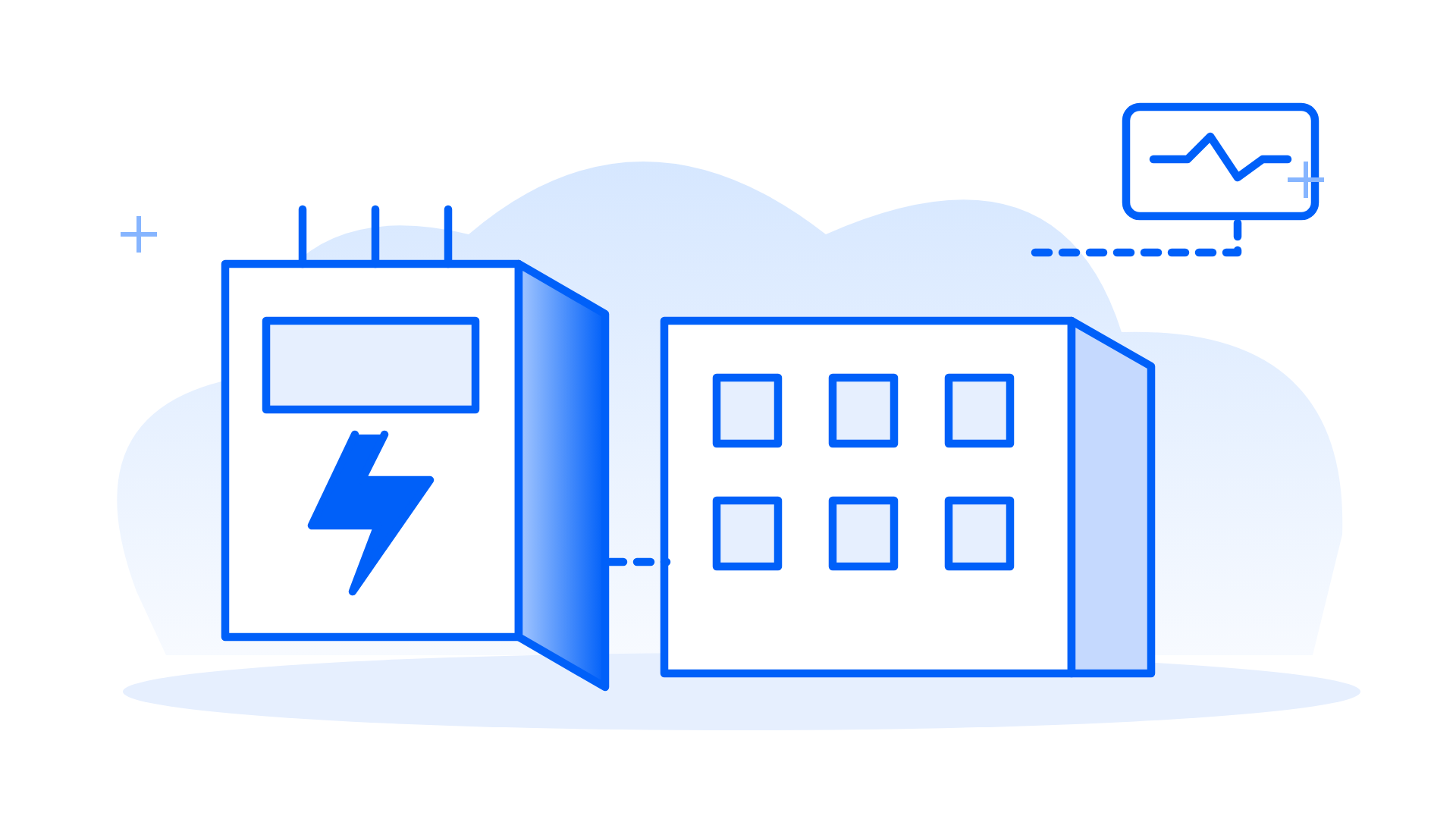 |
The merger discussion arrives as Tesla balances current operations with investment in future products.
$28.05B Q3 2026 REVENUE Tesla | $718M Q3 OPERATING INCOME Tesla | $1.53B Q3 FREE CASH FLOW Company-defined non-GAAP |
Read the earnings before the vision.
Tesla reported essentially flat quarterly revenue and a 56% year-over-year decline in operating income. Net income attributable to common shareholders was $787 million. Those figures describe a business investing heavily while its current earnings face pressure. A potential merger does not remove the need to understand its standalone economics.
Cash creates room to act.
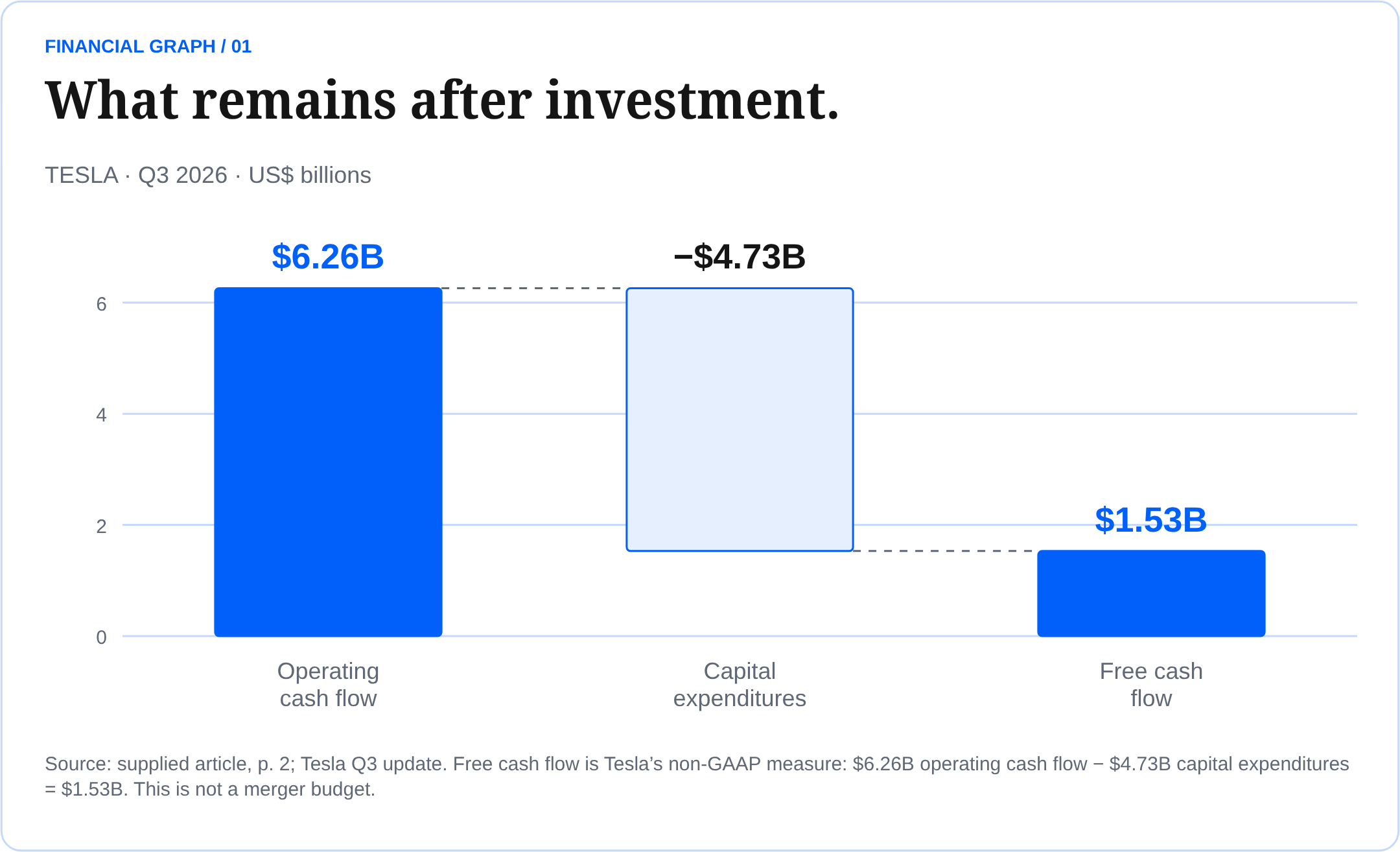
Operating cash flow was $6.26 billion and capital expenditures were $4.73 billion. Subtracting the latter leaves $1.53 billion of free cash flow under Tesla’s definition. Cash, cash equivalents and short-term investments totaled $45.45 billion. Those are financial resources; they are not a disclosed merger budget.
The energy connection.
Tesla says power constraints and data-center demand are creating opportunities for Megapack. That provides a plausible operating connection to a larger computing platform. Our interpretation: the useful test is whether storage deployments earn attractive margins and improve customer economics. A shared owner alone does not prove that outcome.
What deserves a premium?
For a long-term investor, existing earnings and future opportunities need separate treatment. Value the current operations on evidence, then make explicit assumptions for new services. Otherwise, the same hoped-for improvement can appear twice: once in the growth forecast and again in an optimistic valuation multiple.
VALUE THE CURRENT OPERATIONS ON EVIDENCE.
Company-reported Q3 2026 figures. Free cash flow is a non-GAAP measure defined as operating cash flow less capital expenditures. Forward-looking business connections are editorial analysis.
03 / SPACEX / NASDAQ: SPCX LOOK BEYOND |  |
Connectivity and computing explain why this is a broader investment story than launch alone.
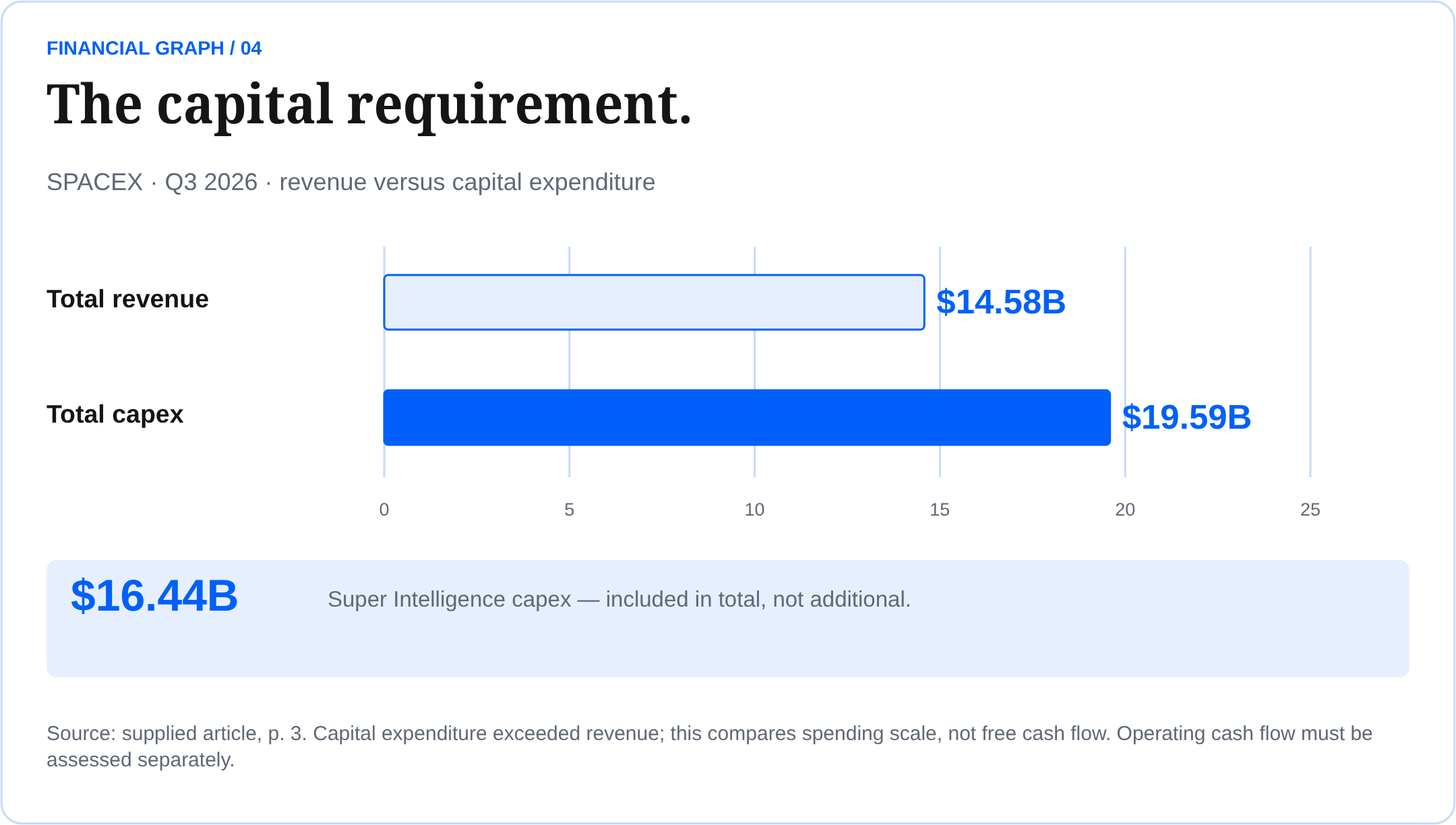
$14.58B Q3 2026 TOTAL REVENUE SpaceX | $2.79B Q3 OPERATING INCOME SpaceX | $19.59B Q3 CAPITAL EXPENDITURES Spending, not an earnings measure |
Three different economic engines.
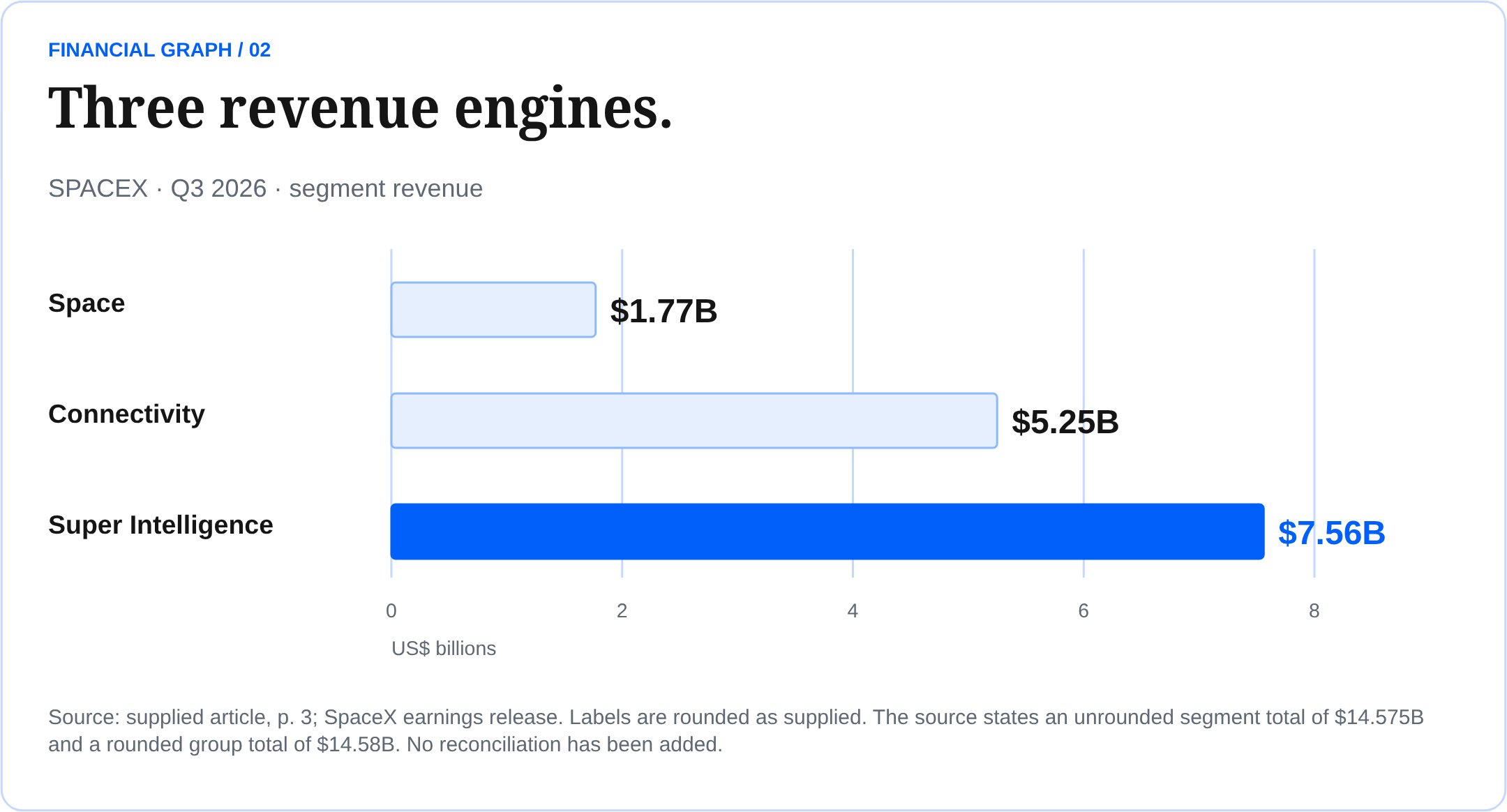
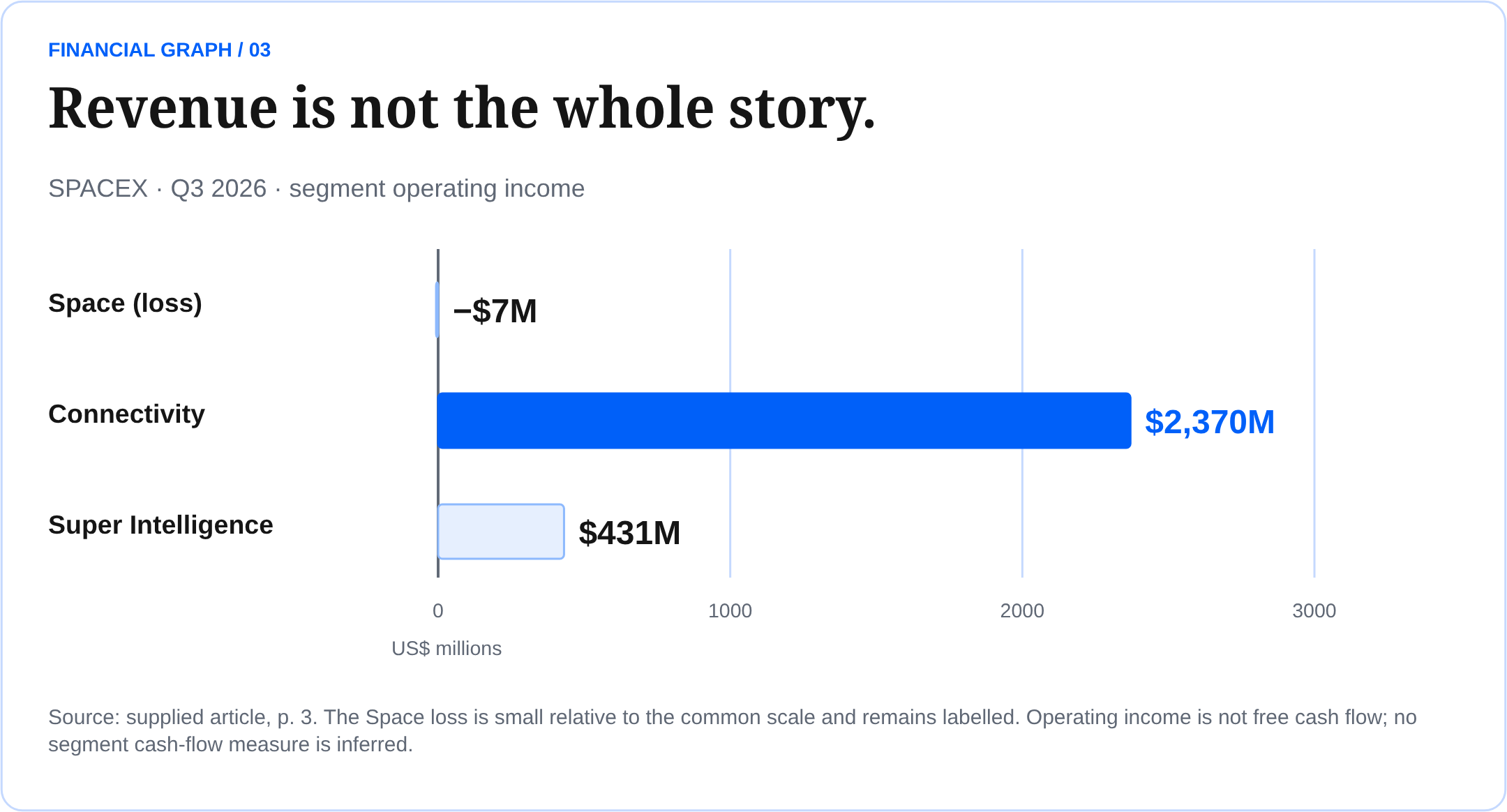
SpaceX reported revenue growth of 161%. Connectivity generated $2.37 billion of operating income, versus $431 million in Super Intelligence and a $7 million loss in Space. Its largest revenue segment and strongest operating-profit contributor were different businesses.
Recurring demand matters.
Starlink had 13.6 million consumer subscribers. Our interpretation: repeatable subscription demand is valuable when retention and pricing support cash generation after the investment needed to maintain the network.
Growth has a capital requirement.
Super Intelligence absorbed $16.44 billion of capex. Total investment exceeded quarterly revenue. That comparison shows spending scale, not free cash flow: operating cash flow must be assessed separately.
A better way to follow the story.
Our approach is to follow segment growth, profitability and capital needs independently. Substantial investment becomes more compelling when utilization, customer payments and cash returns show that installed capacity is earning its keep.
THREE DIFFERENT ECONOMIC ENGINES.
Company-reported Q3 2026 segment figures; rounded in the chart. Capital spending and income from operations are different measures. Segment revenue totals $14.575B. Interpretation is ours.
| Visit TheInvestorCall.com → |
04 / THE INDUSTRIAL LOGIC / EDITORIAL ANALYSIS WHAT COULD COMMON |  |
A persuasive combination needs practical advantages that customers and shareholders can measure.
Energy + connectivity + computing
A possible operating thesis, not an announced integration plan.
Start with the customer problem.
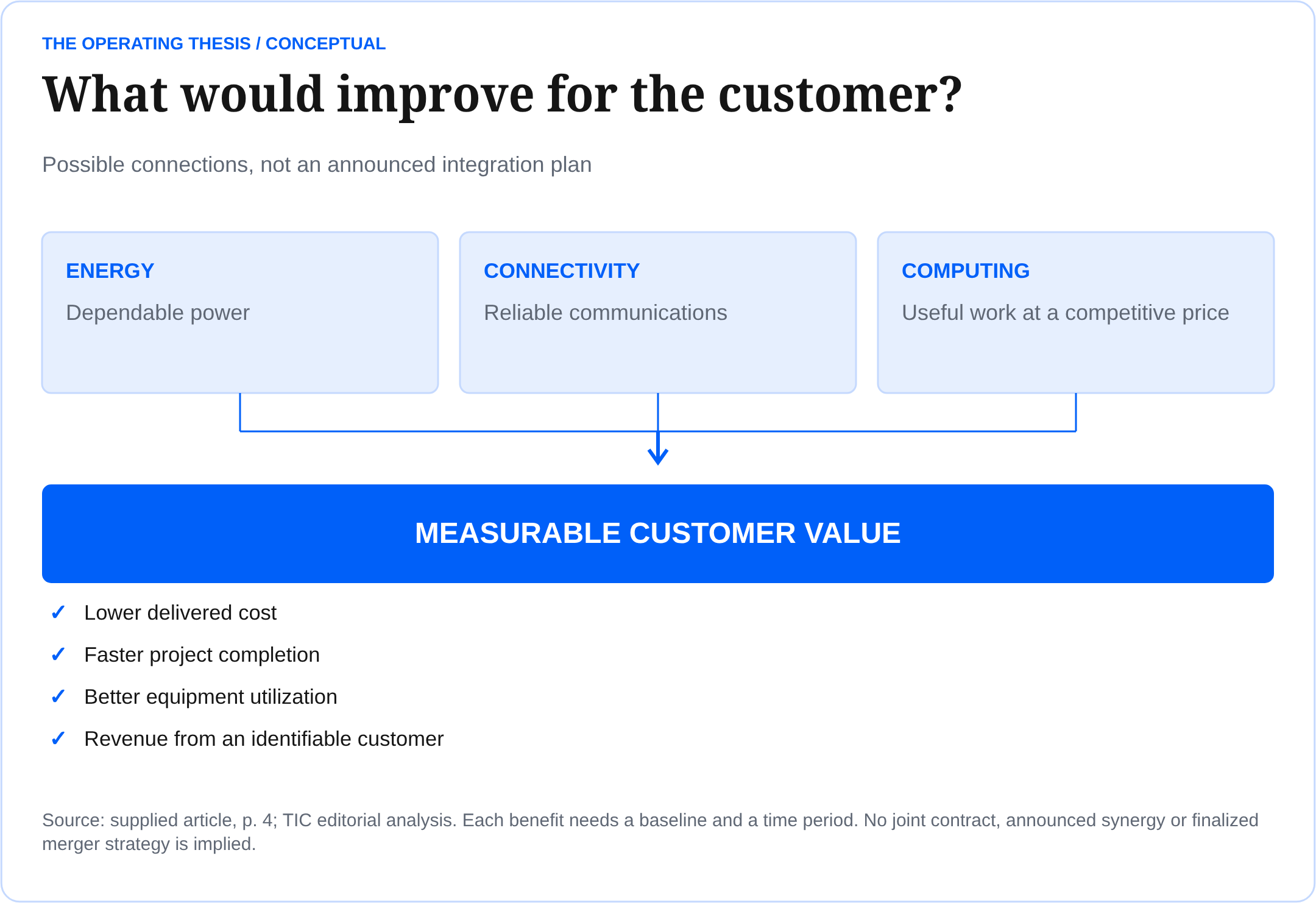
A computing facility needs dependable power. A connected industrial operation needs communications. A software service needs infrastructure that can deliver useful work at a competitive price. The potential attraction is coordinating more of those inputs. Our analysis is a scenario: it does not establish that either company has committed to this operating model.
Count benefits that can be tested.
Useful evidence would include a lower delivered cost, faster project completion, better equipment utilization or higher revenue from an identifiable customer. Each improvement needs a baseline and a time period. A large addressable market describes an opportunity. A paid contract and a cash return reveal whether the company is capturing it.
Ask why a merger is necessary.
Businesses can buy equipment from each other, sign supply contracts or collaborate without combining their shareholder bases. The case for common ownership should therefore show an additional benefit: coordination that contracts cannot achieve efficiently, or capital allocation that produces better returns across the group.
Keep the economics visible.
A larger group should still make its segments understandable. If one operation generates cash while another requires funding, investors need enough disclosure to assess that allocation. Our view: transparency would help shareholders judge whether integration is producing measurable value rather than simply enlarging the corporate perimeter.
COUNT BENEFITS THAT CAN BE TESTED.
This page presents our analytical framework and hypothetical operating connections. It does not describe announced synergies, joint orders, customer contracts or a finalized merger strategy.
05 / THE SHAREHOLDER MATH / ILLUSTRATIVE SCENARIO A BIGGER COMPANY. |  |
The exchange ratio determines how much of a combined business each shareholder group would own.
HYPOTHETICAL ALL-STOCK COMBINATION / NO DEAL TERMS ASSUMED
A: $100B / B: $150B / Total: $250B
At these agreed equity values: A shareholders own 40%; B shareholders own 60%.
Ownership is the starting point.
In this simplified example, the two shareholder groups divide the combined equity according to their agreed contributions. Existing holders may own a smaller percentage of a larger enterprise. That change alone does not establish whether their investment is worth more. The quality of the acquired assets and the consideration paid determine the economics.
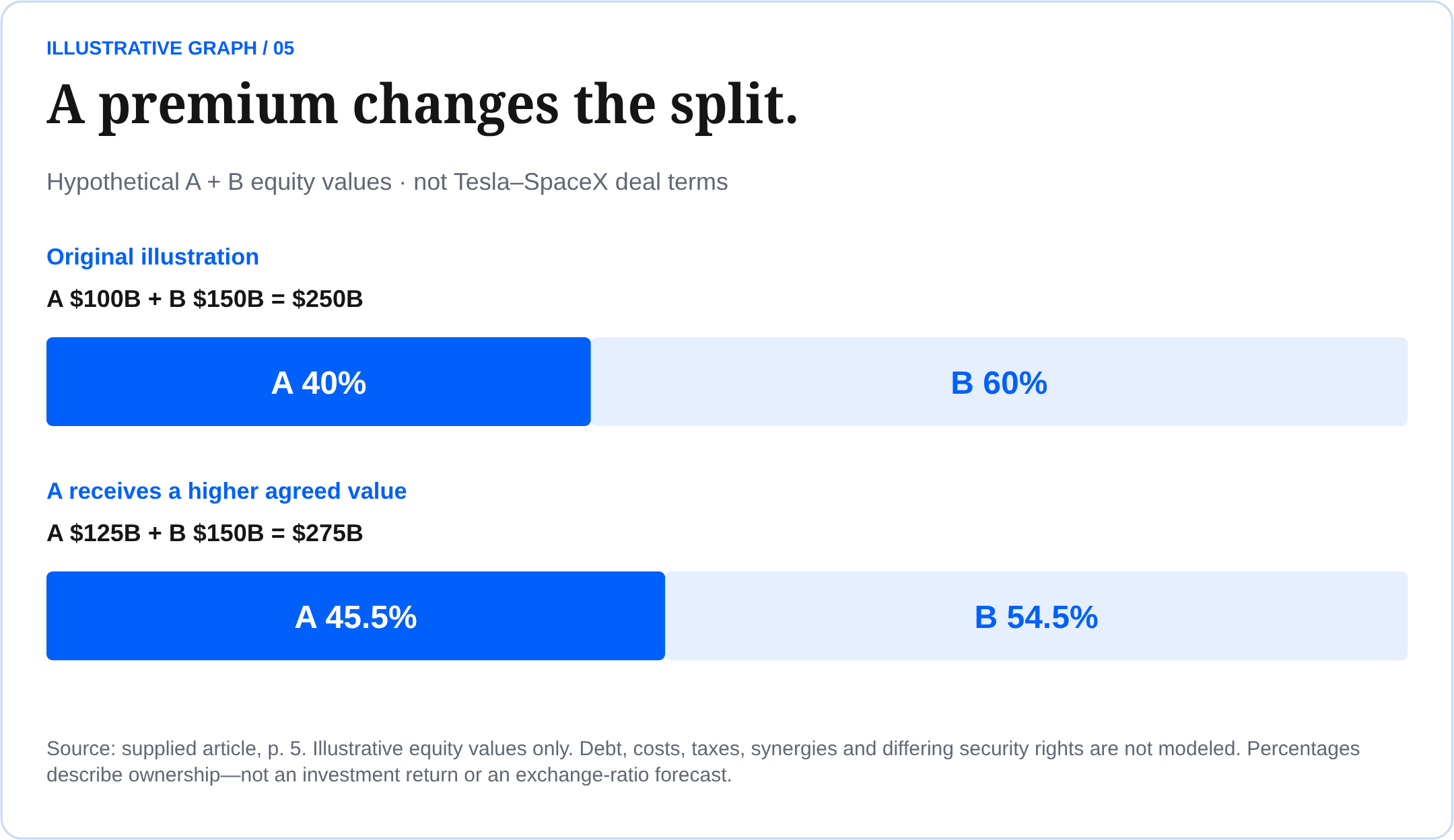
A premium changes the split.
If A’s agreed value rises to $125 billion while B remains at $150 billion, the total becomes $275 billion. A’s holders receive about 45.5% and B’s about 54.5%. This illustrates negotiation arithmetic, not a Tesla or SpaceX forecast. Different share classes, awards and other claims can change real transaction calculations.
Do not price an unsigned agreement.
Until terms are disclosed, investors cannot calculate a reliable transaction return. Market prices, a proposed offer, the share ratio and conditions would all matter. Analyst estimates can be useful scenarios, but they do not create an entitlement for either shareholder group.
The long position needs a foundation.
Our preferred question is whether the standalone business can justify the price paid if discussions end. A completed transaction could add another source of value, but an investment thesis built entirely around an unannounced premium depends on a decision the investor does not control. Sustainable earnings offer a firmer basis for patient ownership.
DO NOT PRICE AN UNSIGNED AGREEMENT.
Illustrative equity values only; no debt, transaction costs, taxes, synergies or differing security rights are modeled. The percentages describe ownership, not a predicted investment return.
06 / THE INVESTOR CALL / RESEARCH BOARD TWO TICKERS. |  |
TSLA and SPCX are the central research subjects. Merger discussion is a catalyst; business performance and terms determine the investment case.
01 Deal status
Watch for a signed agreement and published conditions.
Committees are an exploratory step, not completion.
02 Tesla earnings
Watch operating profitability and cash after investment.
Separate current earnings from future-service assumptions.
03 SpaceX segments
Watch revenue, profitability and capital needs by segment.
Group growth can conceal different underlying economics.
04 Ownership terms
Watch the exchange ratio and fully diluted share counts.
Calculate what each investor would actually receive.
05 Value per share
Watch cash returns and evidence of operating benefits.
Compare the resulting ownership with the price paid.
The opportunity is to understand the businesses before a transaction forces the market to reprice them. A compelling story earns attention. Durable cash generation and sensible terms earn conviction.
EXPLORE YOUR TRADING PLATFORM
| Fidelity | Charles Schwab |
| Interactive Brokers | Tiger Trade |
Access and security availability depend on your country, account and permissions.
RESEARCH THE BUSINESS. INVEST WITH CONVICTION.
GIVE LONG-TERM VALUE TIME TO DEVELOP.
| Subscribe now for free | Get in touch with our team |
| Visit TheInvestorCall.com → |
 Research that matters. Insight you can trust. |  |
Production note: this is a design adaptation of the supplied October 22, 2026 article. Company figures, ticker labels, merger reporting, dates and original link destinations are retained as supplied—not independently verified or updated. The merger remains exploratory in the source; no transaction terms or completion are implied. The ownership graphic is hypothetical. General editorial information, not personalized investment advice.
