 |
|
RESEARCH EDITION | SEPTEMBER 2026
THE HOUSING SIGNAL THE GREAT |  |
THE HOUSE MARKET IS SENDING A SIGNAL. WE LISTENED.
36.5% SALT LAKE CITY share of listings with a price cut | 26.3% UNITED STATES more than one in four listings | 15.5% NEW YORK lowest among the 50 largest metros |
1.62M HOMES FOR SALE August existing-home inventory | 4.9 MONTHS OF SUPPLY highest in more than 10 years | 44.7% BUYER CONCESSIONS Redfin-represented sales, August |
FINANCIAL GRAPH / 01
Where sellers are cutting.
Share of listings with a price cut · supplied September 2026 snapshot
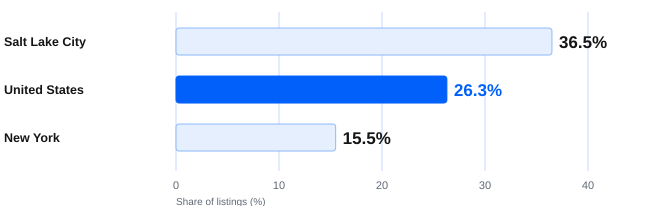
ANOTHER PEAK HERE. ANOTHER LOW THERE. But there is always a way forward. Sellers are cutting, buyers are negotiating, and money is moving. We followed it. |
$100,000 | ONE YEAR AGO → TODAY → 2027
What changed? What matters? And where could the next opportunity be?
Sources: Zillow, Sep. 23, 2026; NAR, Sep. 10, 2026; Redfin, Sep. 18, 2026.
01 / THE MATHEMATICS THE HOUSE HASN'T |  |
For years, low financing costs and tight inventory made housing feel almost unstoppable. Today the pressure point is different: the monthly payment.
FINANCIAL GRAPH / 02
Same mortgage. Different monthly payment.
$400,000 mortgage · 30-year term · principal and interest only
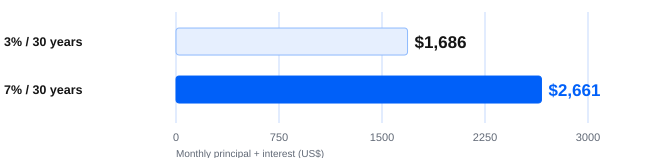
The same house can carry a radically different financing burden. That changes behavior: buyers wait, sellers adjust, transactions slow, concessions rise and builders use incentives to keep deals moving.
A MARKET ADJUSTING - NOT A MARKET DISAPPEARING
August existing-home sales ran at a 3.98 million annual rate, down 2.0% from July, while inventory reached 1.62 million homes and 4.9 months of supply. Yet the median existing-home price was still $429,100, up 1.6% year over year. That is why the signal is more nuanced than a simple "crash" headline.
THE QUESTION If housing is sending an early warning about affordability and liquidity, what do we do with our money? |
Sources: NAR August 2026 existing-home sales report; Redfin August/September 2026 housing-market research. Mortgage illustration is mathematical, principal and interest only.
02 / THE ECONOMIC CHAIN THIS IS BIGGER |  |
A home sale is an economic chain reaction. Mortgage origination, brokerage, insurance, furniture, appliances, renovation, moving and local services all participate. When transactions slow, the effects spread.
 HOUSING TRANSACTION |  MORTGAGE + BROKERAGE |  RETAIL + RENOVATION |  CONSUMER SPENDING |
MORTGAGES Fewer transactions and fewer refinancings make housing activity central to the earnings story. |
MARKETPLACE Zillow needs an active marketplace. Volume can matter as much as headline home prices. |
NEW SUPPLY Builders can use rate buydowns, incentives and financing packages that ordinary sellers cannot. |
TURNOVER Big discretionary projects often follow a move. Lower turnover can soften that spending impulse. |

RENTAL DEMAND If ownership stays difficult, households still need a place to live - supporting rental demand. |
BUYER POWER Nearly half of Redfin-represented sales included a seller concession in August 2026. |

BUT THIS ISN'T OUR INVESTMENT STRATEGY. It is the beginning of the investigation. Housing shows us where pressure is building. Now we ask where capital can go instead. |
Sources: Redfin August 2026 buyer/seller and concessions research; NAR August 2026 existing-home sales report.
03 / FOLLOW THE MONEY ENOUGH ABOUT |  |
Markets do not stop because housing slows. Capital does not disappear. Consumers keep buying. Patients still need medicine. Governments still fund defense. Data centers still need electricity. AI still needs chips, networking and infrastructure.
DON'T JUST FOLLOW THE PROBLEM. FOLLOW THE MONEY.
|
|
|
|


|
|


|

SEVEN COMPANIES. SEVEN ECONOMIC ENGINES. Not seven versions of the same bet. The research board deliberately spans consumer demand, power, defense, healthcare, AI infrastructure and emerging technology. |
Editorial framework: The Investor Call. Company categories are research themes, not guaranteed outcomes.
04 / THE RESEARCH BOARD SIX ENGINES |  |
Established businesses that give the research board different sources of revenue, demand and economic exposure.
PEOPLE STILL BUY. Value, groceries and household essentials. Sep. 25 close: $107.98. TTM revenue: about $735.8B. |
PEOPLE KEEP COMING BACK. Membership, loyalty and value-oriented consumption. Sep. 25 close: $922.77. |
AI NEEDS POWER. Electricity is the physical layer beneath data centers, electrification and the digital economy. Sep. 25 close: $76.08. |
A DIFFERENT ENGINE. Defense and aerospace programs operate on a very different cycle from residential property. Sep. 25 close: $519.56. |
HEALTHCARE DOESN'T WAIT. Medicine, innovation and demographics create demand drivers independent of housing. Sep. 25 close: $1,183.46. |
AI NEEDS INFRASTRUCTURE. Chips, networking and connectivity sit underneath the AI buildout. Sep. 25 close: $352.81. |
THE COMMON THREAD None of these businesses requires the U.S. housing market to return to pandemic-era conditions in order for its core economic engine to exist. That is the alternative: stop waiting for one market to become perfect and investigate where demand is already present. |
Market data: public company disclosures and market data through Sep. 25, 2026. Sector descriptions are editorial summaries.
|
05 / THE EMERGING-TECH POSITION AND THEN |  |
SPECTRAL CAPITAL CORP.
AI. QUANTUM. DATA INFRASTRUCTURE. The emerging-technology position on The Investor Call research board. |
$646.8M REVENUE first six months of 2026, per S-1/A | $4.85 FCCN CLOSE Sep. 25, 2026 | OTCQB CURRENT MARKET Nasdaq Capital Market application filed |
Spectral's September 18 amended S-1 describes a company that has moved into a substantially different operating scale. The filing reports approximately $646.8 million of revenue for the first six months of 2026 and says its common stock is currently quoted on OTCQB under FCCN.
THE NEXT CAPITAL-MARKETS CHAPTER
Spectral has applied to list FCCN on the Nasdaq Capital Market under the same ticker. The application is not yet an accomplished listing, but it is a concrete milestone to watch alongside commercialization, acquisitions, intellectual property and execution across AI, quantum and data infrastructure.
WHY IT IS ON OUR BOARD
FCCN gives the research board exposure to emerging technology rather than another defensive consumer or housing-linked business. It is there because The Investor Call wants to measure what happens when technology, operating scale and capital-market development meet.
THAT IS WHY FCCN IS ON OUR BOARD. Different engine. Different catalyst set. Same rule: research it, document it, and measure what happens next. |
Source: Spectral Capital Corp. Form S-1/A filed with the SEC Sep. 18, 2026; market price source: S&P Global Market Intelligence via StockAnalysis, Sep. 25, 2026.
06 / THE ONE-YEAR COMPARISON ENOUGH TALK. |  |
WHAT IF WE HAD STARTED ONE YEAR AGO?
We set a simple discipline: one date, one basket, no rewriting history. The table below shows verified Sep. 26, 2025 closes where retrieved and Sep. 25, 2026 closes. It is the framework for the full $100,000 model portfolio.
FINANCIAL GRAPH / 03
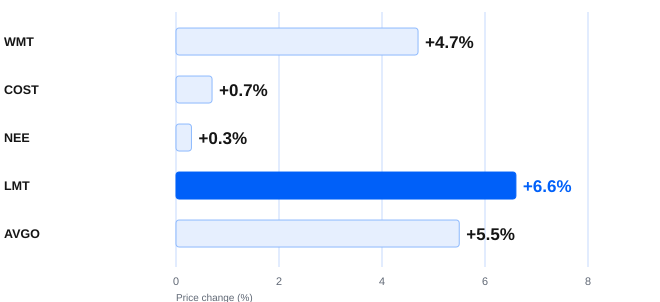
Different engines. Different outcomes.
Sep. 26, 2025 → Sep. 25, 2026 · five supplied price changes
WHY WE DO NOT HIDE THE FLAT NAMES
A real research board is not supposed to produce seven identical lines. Walmart, Costco and NextEra were comparatively flat over this measurement window, while Lockheed Martin and Broadcom were higher. That contrast is useful: diversification means different engines behave differently.
$100,000 → A MEASURABLE EXPERIMENT For the published model portfolio, allocate the capital consistently, record the exact entry prices and track every position. The purpose is not hindsight. The purpose is accountability. |
MODEL-PORTFOLIO NOTE FCCN and LLY remain on the seven-stock board; their exact one-year entry-price calculations should be locked from the same market-data source before the model portfolio is treated as a final performance record. |
Illustrative research-board framework. Historical-price calculations should be treated as a model portfolio, not personalized investment advice.
07 / THE STARTING LINE NOW WE |  |
SEPTEMBER 2026 | $100,000 | SEVEN STOCKS | ONE YEAR
We have examined housing. We have followed the economic consequences. We have looked beyond real estate. Now we establish the starting line for the 2026 → 2027 research experiment.
BEAR Growth slows; valuations compress; housing stays difficult. | BASE Businesses execute broadly in line with operating trends. | BULL AI investment, power demand and growth catalysts accelerate. |
ANOTHER PEAK HERE. ANOTHER LOW THERE.
But there is always a way forward.
Anyone can repeat a housing statistic. The Investor Call wants to understand why it is happening, what it changes, which businesses feel it and where capital could move next. We look beyond the problem. We follow the money. We build the research board. And then we measure what happens.
THE INVESTOR CALL Research that matters. Performance you can measure. Insight you can trust. |
Starting prices use Sep. 25, 2026 closes where available. 2027 outcomes are scenarios, not forecasts. Past performance does not guarantee future results.
Production note. Article wording, figures and source references are retained from the supplied September 2026 draft. The charts visualize the supplied observations only; the underlying market data and company status have not been independently verified or updated. No missing entry prices, allocation weights, full-portfolio return or numerical 2027 forecasts have been invented.
|
 Research that matters. Insight you can trust. www.theinvestorcall.com |  |
