
| Visit TheInvestorCall.com → |
THE COMMERCIAL TURNING POINT / OCTOBER 20, 2026 QUANTUM COMPUTING: |  |
The machines are improving. Who will pay to use them—and which companies could turn scientific progress into lasting value?
A BETTER BATTERY. A BIGGER BUSINESS.
Imagine a battery manufacturer searching for a material that stores more energy, charges faster and lasts longer. This is a hypothetical company, but its commercial problem is familiar: every candidate takes time to simulate, manufacture and test. A wrong turn consumes money long before a product reaches a customer.
A computing service that helped researchers select better candidates could earn a place in that process. Its value would lie in fewer failed experiments, faster development or a more competitive battery. Those benefits would have to be measured against the best conventional methods.
On October 19, Quantinuum reported 99.9995% logical memory fidelity on Helios: roughly five logical failures per million error-checking cycles in the specified experiment. The company described a tenfold reduction from its September memory-error result. Read the technical account.
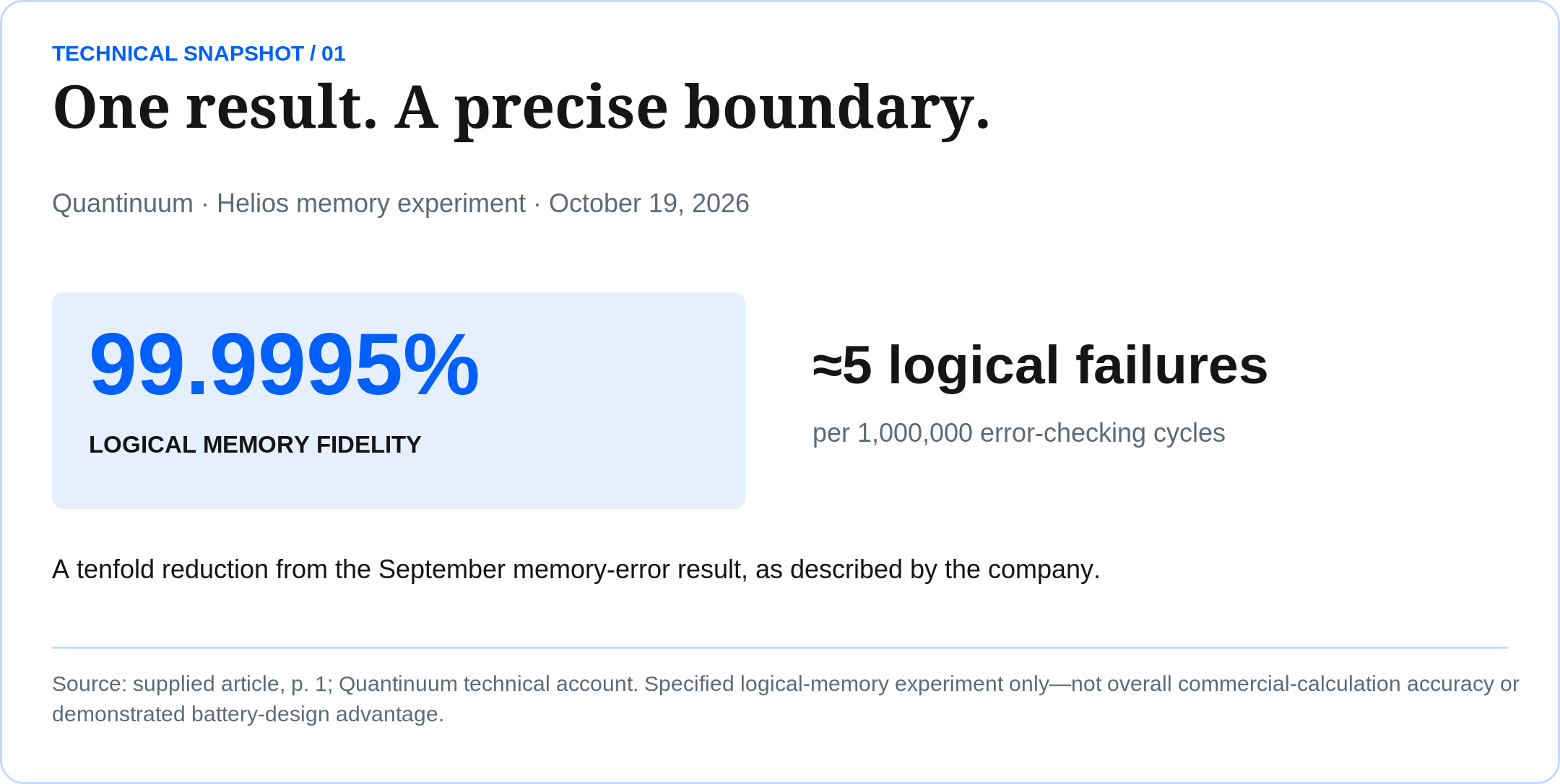
That is progress in protecting quantum information. It is not a claim that every commercial calculation is 99.9995% accurate, or evidence that our battery manufacturer can already develop a superior product. The result matters because useful, longer calculations need dependable information.
What would a customer pay for a result that improves its business?
THIS EDITION The technology. The revenue. The timeline. Five stocks.
PRIMARY SOURCES Quantinuum • October 19, 2026
01 / WHAT THE TECHNOLOGY COULD CHANGE A DIFFERENT TOOL |  |
A quantum computer uses qubits, physical systems whose quantum states can be manipulated to perform calculations. Algorithms use interference to strengthen useful signals. Measuring the machine returns limited information; it does not hand the user every possible answer.
A physical qubit is an individual hardware element. A logical qubit encodes information across a protected group of physical qubits. Error correction repeatedly checks for signs of damage and uses those checks to preserve the encoded state. More qubits help only when the hardware and correction process are reliable enough. Google’s explanation.
THE APPLICATIONS MUST EARN THEIR PLACE
CHEMISTRY & BATTERIESA materials team wants more accurate estimates of how electrons behave in candidate compounds. Better predictions could focus laboratory spending. Google and collaborators have developed algorithms and resource estimates for future error-corrected machines; that work is not proof of industrial battery-design advantage today. | PHARMACEUTICALSResearchers could investigate selected chemical reactions relevant to drug metabolism. The potential benefit is better scientific understanding and more focused experiments. The evidence needed is accurate, reproducible results at a useful cost—not a promise that a quantum computer will discover a finished medicine. | |
INDUSTRIAL MATERIALSCatalysts, magnetic materials and other complex systems are candidates for simulation research. A manufacturer would need a calculation that changes a real decision. The test includes comparison with improving conventional simulation, the cost of preparing the problem and the cost of running it. | FINANCIAL CALCULATIONSSelected pricing, sampling and optimization problems are research targets. An algorithmic speedup alone does not establish a cheaper service. Data loading, accuracy, operating costs and strong conventional alternatives belong in the comparison. This is a potential application category, not a demonstrated industry-wide advantage. |
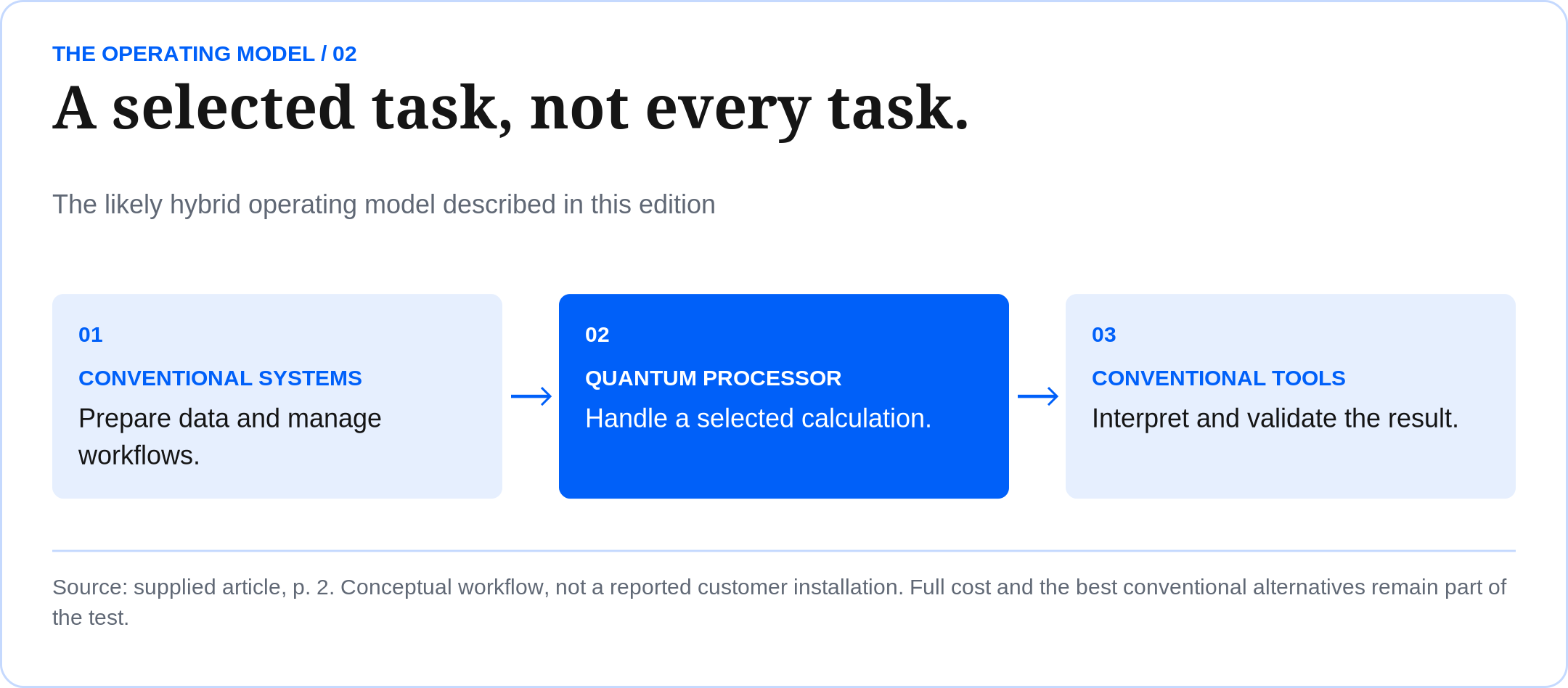
The likely operating model is hybrid: conventional systems prepare data and manage workflows; a quantum processor handles a selected task; conventional tools interpret and validate the result.
PRIMARY SOURCES Error correction | Industrial simulation research
02 / WHERE THE REVENUE COMES FROM THE FIRST INVOICE |  |
Commercial activity has already begun. Customers can buy access to systems, commission research, purchase hardware and pay for software or integration. The unanswered question is how much of that spending becomes durable demand supported by measurable customer value.
THREE NUMBERS. THREE DIFFERENT MEANINGS.
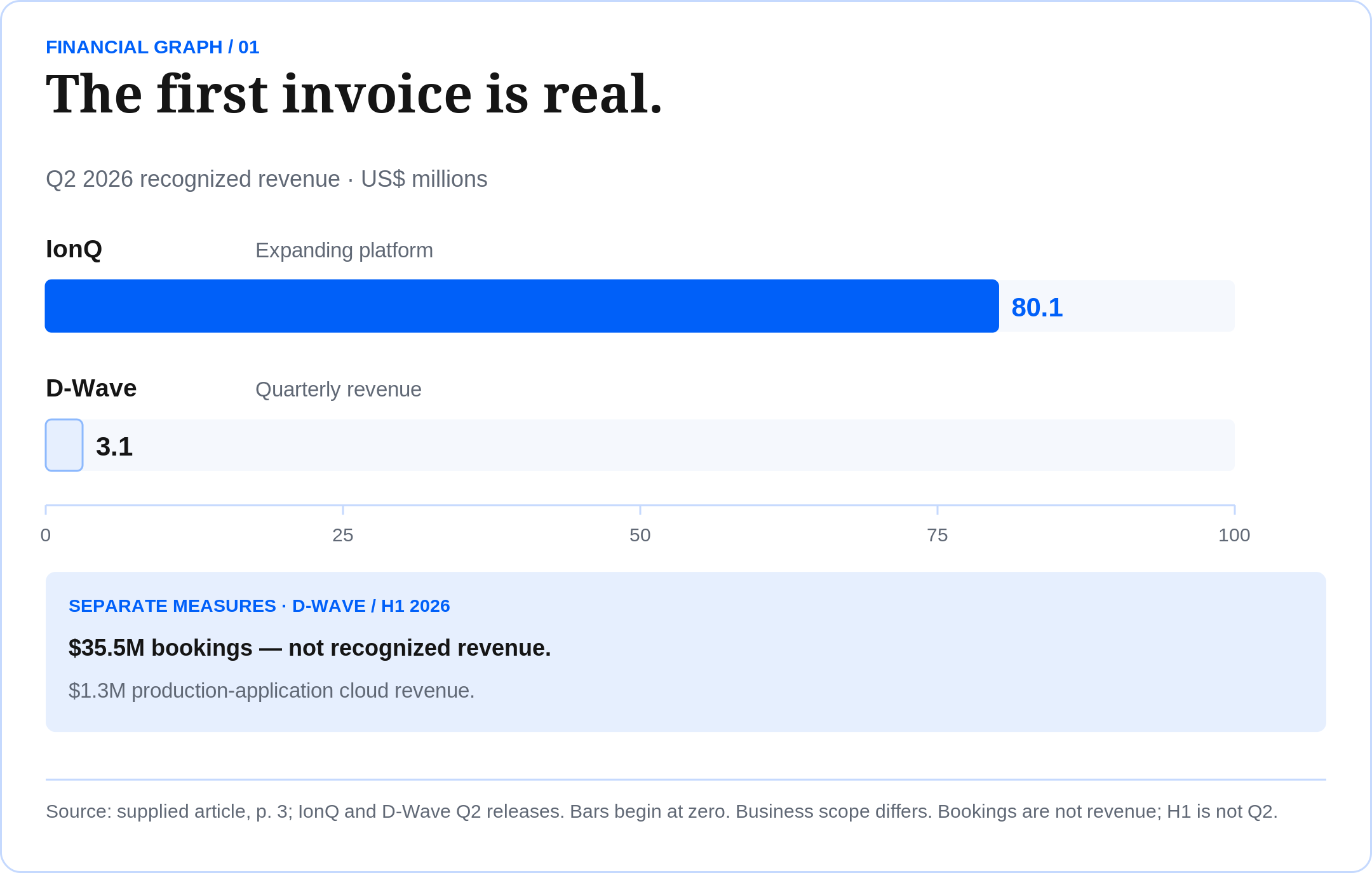
IonQ’s figure covers its expanding platform, not solely payments for quantum calculations. Acquisitions and product mix matter. D-Wave’s first-half bookings included a $20 million system sale whose revenue was to be recognized later. Its first-half production-application cloud revenue was $1.3 million. These are different measures of business activity, not interchangeable market-size estimates.
HOW A PROJECT BECOMES A BUSINESS
In our hypothetical battery company, a paid pilot begins with a narrow question and an agreed benchmark. The supplier may charge for compute access and specialist work. A hardware installation can add delivery, integration and maintenance obligations; a cloud service can charge for reserved capacity or usage. Software and support may produce further fees.
The finance director funds a second project only after comparing the full cost with the value created. Repeat use then has a chance to move from an experimental research budget into regular operations. Government and university contracts can fund useful development, although their purchasing cycles differ from factory demand.
Read the accounting: recognized revenue records delivered obligations under the relevant rules. Bookings track company-defined orders. Backlog and remaining performance obligations describe future work with specific definitions. Grants may support research; a partnership announcement may carry no committed spending at all.
A customer relationship becomes more valuable when the customer chooses to return.
PRIMARY SOURCES IonQ • Q2 results | D-Wave • Q2 results
| Visit TheInvestorCall.com → |
03 / WHEN DOES THE MARKET BECOME MEANINGFUL? THERE IS NO |  |
Quantum computing has several commercial clocks. Research access is already sold. Specialized production applications are emerging. Broad, repeatable advantage on demanding industrial problems requires further evidence. A company roadmap tells us what management intends to build; a customer renewal tells us what somebody values.
NOW
Access and experimentation
Cloud services, installations and paid development already exist. IBM offers platform access and software tools; D-Wave reports production-application cloud revenue. Paying to explore a technology is an established business, even when the final application remains experimental.
2026–2028
Engineering and validation targets
IBM’s roadmap targets examples of quantum advantage and progress in real-time decoding, logical processing and modular hardware. These are company targets. Investors should seek published results, demanding comparisons and evidence that an improvement survives outside a carefully chosen demonstration.
2029 & BEYOND
Fault-tolerant systems; adoption still to prove
Quantinuum targets Apollo in 2029. IBM targets Starling in 2029. Fault tolerance means computing can continue reliably despite errors through system design and correction. Delivering such hardware would not itself guarantee profitable applications or a simultaneous industry-wide rollout.
THE SIGNALS WORTH WATCHING
Look for independent assessment against the best available conventional approach; customer renewals and expanding workloads; rising useful utilization; and improving economics after hardware, support and integration costs. A faster processor is encouraging. A customer paying more because the service reliably solves a valuable problem is a stronger business signal.
Our interpretation: adoption will be uneven. A narrow application can justify spending before a broad platform matures. Investors can follow those milestones without assuming every announced target arrives on time.
PRIMARY SOURCES IBM roadmap | IBM platform | Quantinuum target | D-Wave adoption
04 / FIVE STOCKS, FIVE INVESTMENT CASES FIVE STOCKS. |  |
These are research candidates, not an equal-weight portfolio or a ranking. Their quantum exposure, operating foundations and funding needs differ substantially.
IBM / NYSE
The enterprise platform
Software, consulting and infrastructure provide its operating foundation. IBM reported $4.8 billion of first-half 2026 free cash flow, a company-defined non-GAAP measure, and plans more than $10 billion of quantum investment over five years. Its opportunity spans hardware, software and integration. Watch evidence behind its Starling roadmap and conversion of enterprise experiments into repeat spending.
GOOGL / NASDAQ
Research backed by a large business
Alphabet’s advertising and cloud operations finance a broad technology portfolio. At June 30 it reported $242.5 billion in cash, cash equivalents and marketable securities. Google’s Willow research demonstrated improving error protection as code size increased. Quantum is one part of a much larger investment case. Watch useful algorithm demonstrations and a clearer route from research to customer services.
IONQ / NYSE
A broader quantum platform
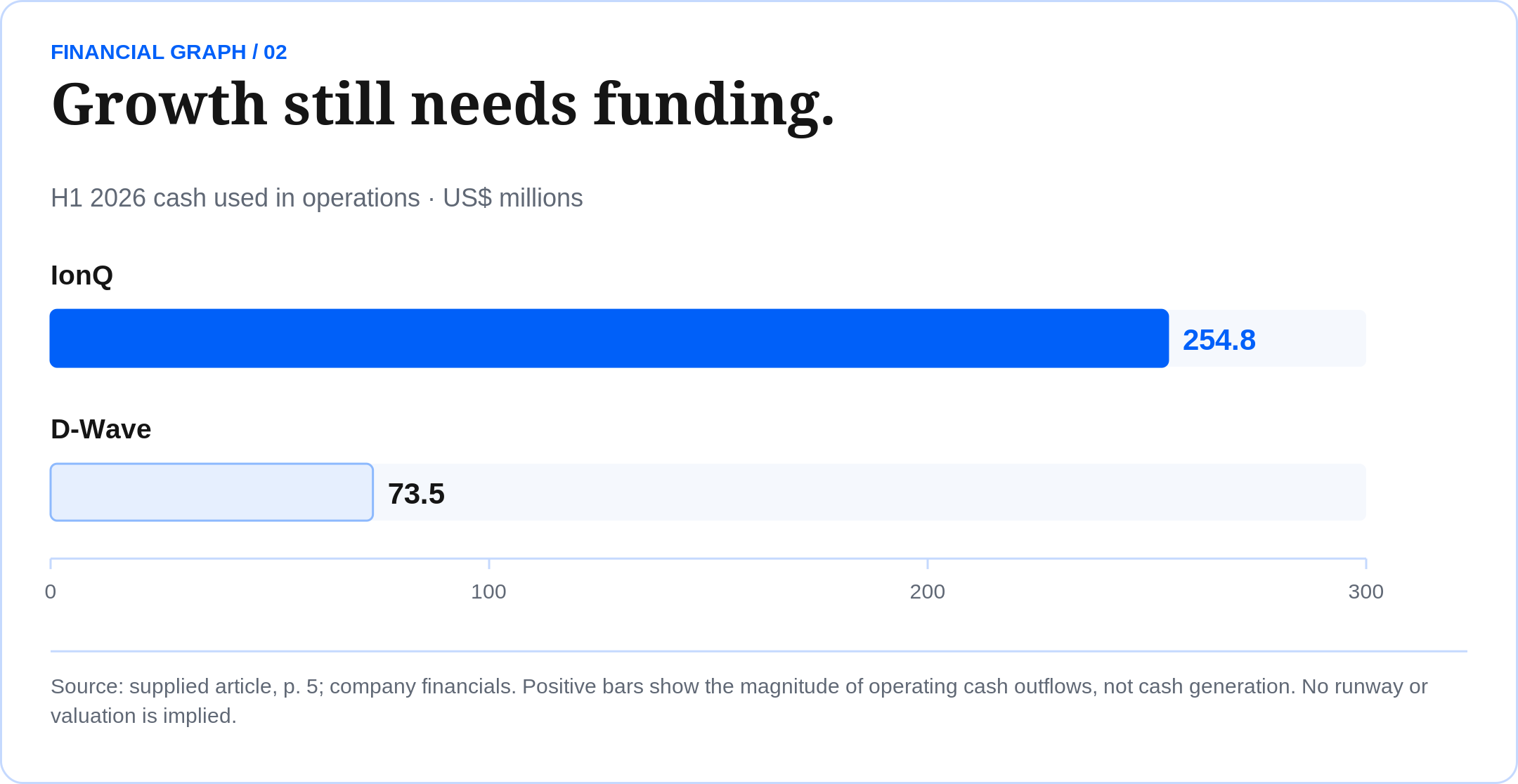
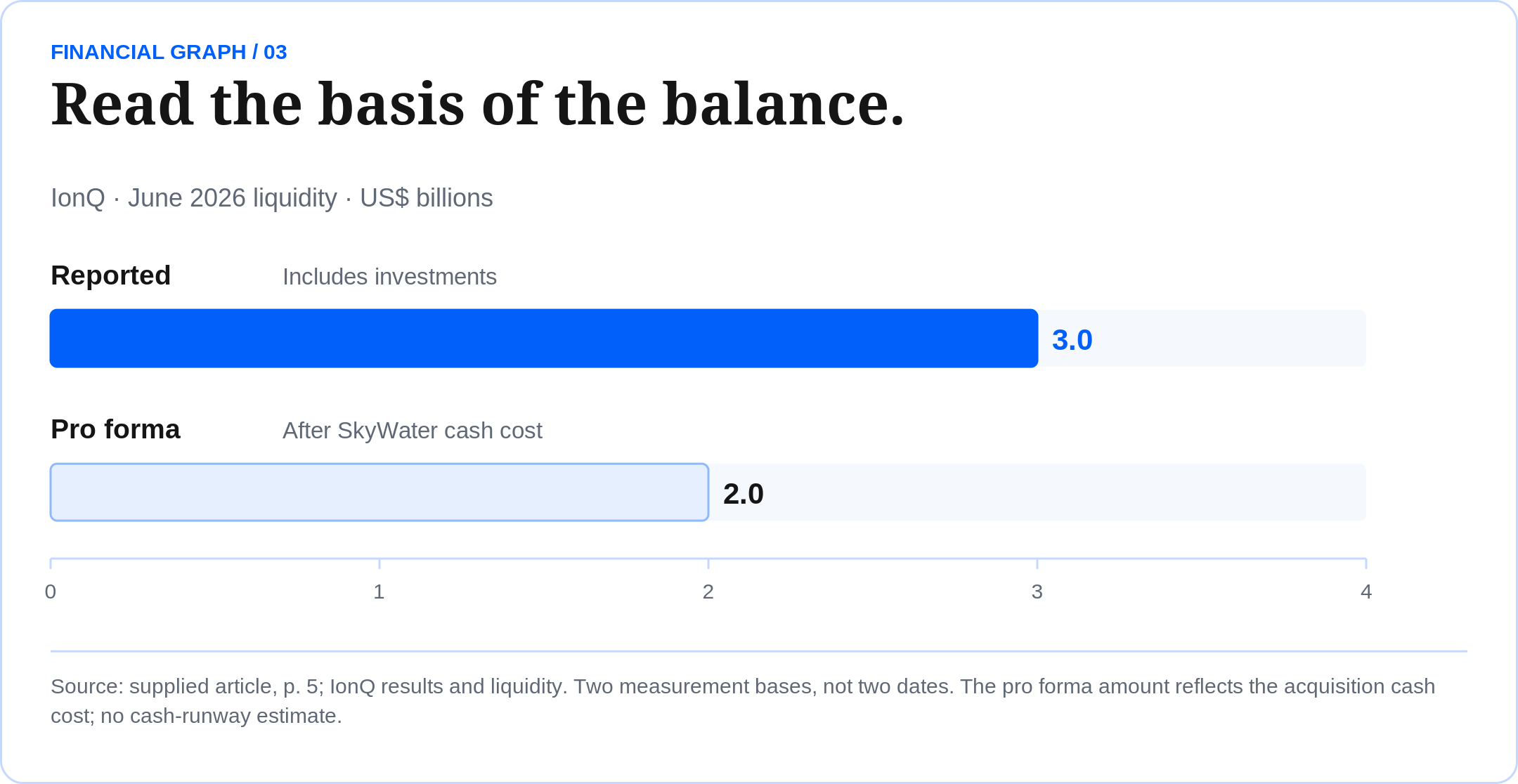
IonQ combines trapped-ion computing with networking, sensing and security activities. Q2 revenue was $80.1 million. June liquidity was $3.0 billion including investments, or $2.0 billion pro forma after the SkyWater acquisition cash cost. Growth is not yet self-funding: first-half operating cash use was $254.8 million. Watch integration, revenue mix, repeat deployments and technical validation.
QBTS / NASDAQ
A different route to useful work
D-Wave’s annealing systems seek low-energy solutions to formulated optimization problems; this differs from programmable gate-based computation. It also pursues gate-model development. June cash was $296.6 million; first-half operating cash use was $73.5 million. Watch cloud production revenue, delivery of booked systems and repeat customers rather than treating annealing qubit counts as equivalent to logical gate-model qubits.
FCCN / OTCQB
Infrastructure today; optionality to assess
Spectral operates international voice and messaging services through Telvantis Voice Services and 42 Telecom. The application, filed on September 18, outlines research and development goals in the field of quantum computing. Among other things, the application lists 21 filed patent applications, 19 internal patent applications that have not yet been filed, and preparations for additional patents. Cash on hand totaled 5.3 million U.S. dollars in June. Key points to note include the funded implementation, measurable customer gains, and the generation of cash.
05 / FROM BREAKTHROUGH TO REPEAT BUSINESS THE SECOND |  |
Return to our hypothetical battery manufacturer. Its researchers finish a tightly defined pilot. They compare the result with a conventional approach, include every relevant cost and show that the new process improves a decision. The finance director approves another project.
This illustrative future scenario captures the commercial turning point: a customer returns because the work is worth paying for. As projects meet that test, the supplier can build a more predictable business.
FIVE QUESTIONS BEFORE A LONG-TERM POSITION
Technical progress: does the result survive credible comparison?
Customer value: does it improve a decision enough to justify its full cost?
Repeat revenue: are customers renewing and expanding?
Financial endurance: can the supplier fund development and delivery?
Valuation: how much future success is already in the share price?
Our investment interpretation is constructive but selective. Useful computing can create valuable businesses. Shareholders benefit only when commercial progress, financing and the price paid leave room for attractive returns. A breakthrough deserves attention; the operating evidence deserves continued research.
The next chapter of quantum computing will be written in laboratories. Its investment case will be tested in customers’ budgets.
STAY CLOSE TO THE COMPANIES BUILDING THE FUTURE
Follow The Investor Call for clear research connecting technology with business and investing.
| Subscribe now for free. | Get in touch with our team |
www.theinvestorcall.com | Get in touch with our team
EXPLORE TRADING PLATFORMS
| Fidelity | Charles Schwab |
| Interactive Brokers | Tiger Trade • regional site |
Availability depends on residence, account permissions and the security. Tiger’s regional routing must be checked for your location. Confirm OTC access and FCCN eligibility directly with the broker.
Research dated October 20, 2026. Financial figures refer to the periods stated; roadmaps are company targets. Hypothetical scenes illustrate potential economics. This newsletter is general information, not personalized investment advice.
| Visit TheInvestorCall.com → |
 Research that matters. Insight you can trust. |  |
Production note. Wording, figures and original link destinations are retained from the supplied article. Charts visualize only supplied figures; distinctions between revenue, bookings, cash balances and cash use remain explicit. Company claims and targets have not been independently verified or updated. No stock-price history or future return has been added.
