
| Visit TheInvestorCall.com → |
01 / ENERGY / PROFITS / PRICING POWER / NOVEMBER 2, 2026 EXPENSIVE OIL. |  |
The same barrel can lift one company's earnings and squeeze another. Follow the cash through the economy.
Issue date: November 2, 2026 · Prepared October 31, 2026
| XOM | CVX | SLB | DAL | FCCN |
An oil price is more than a number on a trading screen. It becomes a fuel bill, an operating cost, a production decision and, eventually, a household spending choice. That is why an energy story can reach far beyond the energy sector.
For investors, the useful question is which business can retain more cash as conditions change. Producers, service providers and transport companies have different exposures. Buying all three on the same headline misses those differences.
This edition examines ExxonMobil, Chevron, SLB and Delta, then adds Spectral Capital as a separate technology implementation opportunity. FCCN belongs in the discussion through its own operating evidence, rather than an assumed link to crude prices.
Our investment approach favors staged entries in businesses whose economics remain attractive under a more ordinary environment. The strongest company on a favorable commodity day is not automatically the best investment at every price.
The strongest company on a favorable commodity day is not automatically the best investment at every price.
Prepared October 31, 2026 for the stated issue date. Advance analysis; scheduled events may change. No future results are assumed. All investment views require a current quote and filing review.
02 / THE PRODUCERS / XOM + CVX A HIGHER PRICE. |  |
ExxonMobil and Chevron offer direct exposure to energy economics. Purchase discipline still matters.
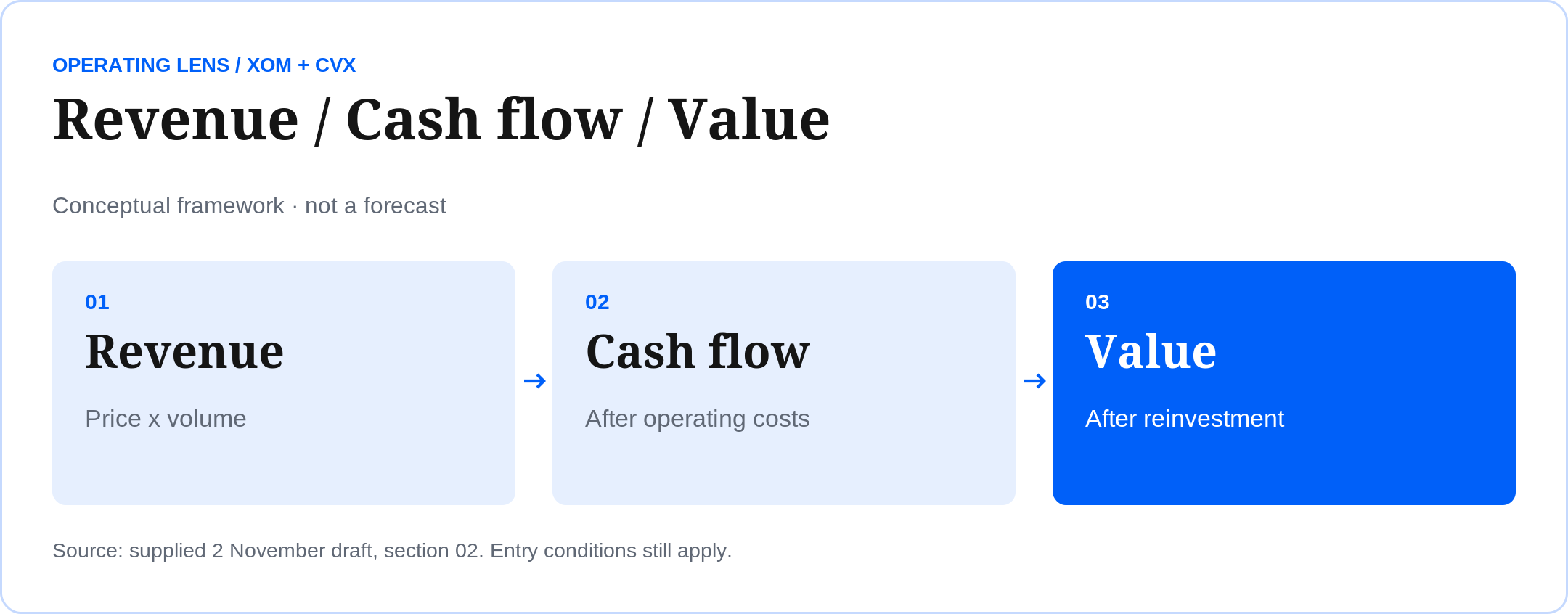
The investment case
ExxonMobil and Chevron are integrated energy businesses. Their upstream operations expose them to production economics; other operations broaden the earnings mix. That structure makes the relationship between a crude-price move and consolidated profit less simple than it first appears.
Our editorial preference is to consider these names for a staged energy allocation when conservative cash-flow estimates support the purchase price. Build the case using a normalized commodity assumption, maintenance spending and the money required to preserve the asset base.
A useful entry should leave room for ordinary setbacks. If the investment only works when oil remains unusually expensive, the investor is principally making a commodity forecast.
What would justify buying?
Look for operating cash that can support necessary investment and shareholder distributions without relying on repeated borrowing. Compare the latest balance sheet with management's capital commitments and use a consistent period for both companies.
A dividend is part of the return, but the quality of its funding matters more than its headline yield. Likewise, buybacks create value only when the price paid is sensible and future investment remains funded.
Our recommendation: research XOM and CVX as core energy candidates, then accumulate in portions only when the current valuation passes a lower-oil-price stress test. Neither receives an unconditional buy-at-any-price call.
ENTRY RULE
Underwrite ordinary oil prices before paying for extraordinary conditions.
Editorial analysis. Investment views are conditional on current valuation and verified disclosures.
03 / THE SERVICE CYCLE / SLB WHO GETS THE |  |
The investment cycle can outlast a daily commodity move, but customers must actually commit capital.
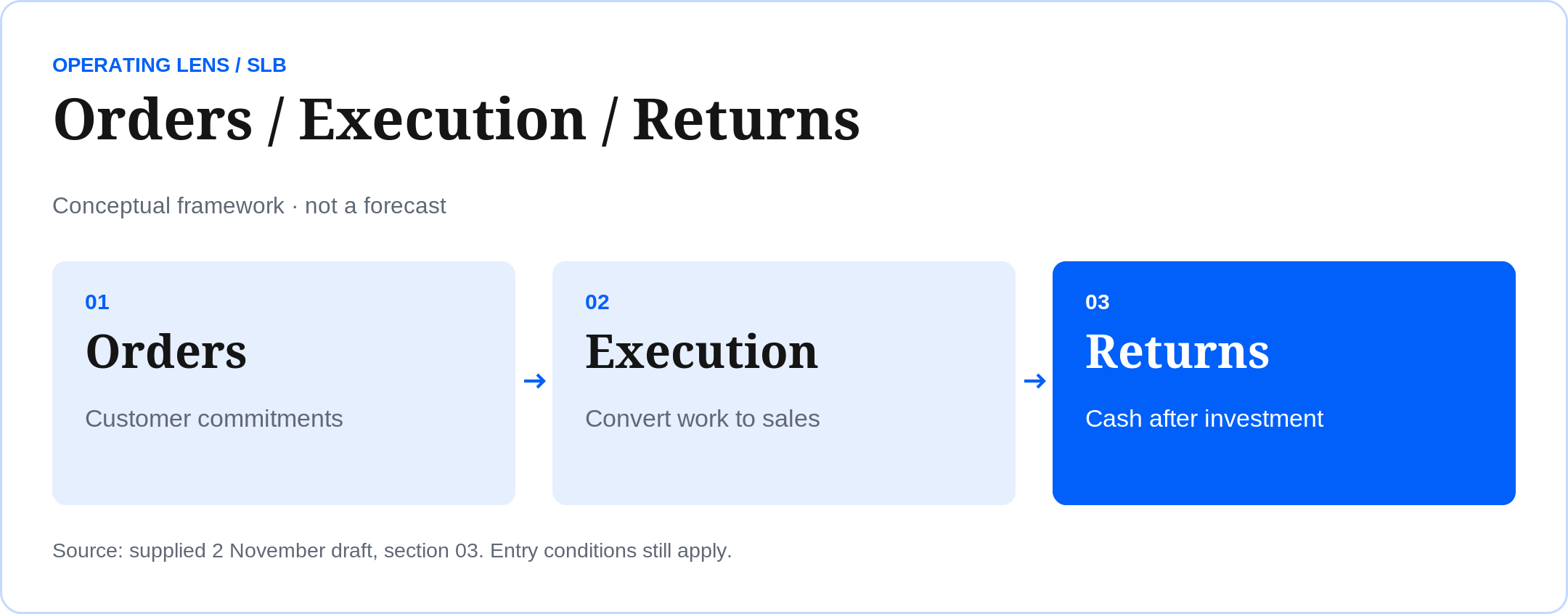
Activity is the transmission
SLB provides technology and services to energy customers. Its investment relevance comes through customer activity, project economics and the value its tools and execution can deliver. A stronger oil price may improve a customer's willingness to invest, but that spending can take time to arrive.
For that reason, the research task is to distinguish an improved environment from an improved order book. Examine the latest company reporting for activity, pricing, geographic mix and cash conversion. A promising conversation is not the same as a contracted project.
Our preferred evidence is growth that survives beyond a single quarter and produces cash after the investment needed to serve customers.
Buy the economics, then the story
An investor can pay too much even for a strong cycle. Compare the valuation against a range of activity outcomes and allow for slower project awards. A multiple that appears modest against peak earnings can be expensive against normal earnings.
Our recommendation: consider SLB as a conditional growth allocation when customer commitments and operating execution support the thesis. It is a different role from owning a producer, so avoid treating both positions as independent diversification.
Before buying, write down the development that would strengthen the case and the development that would invalidate it. That discipline makes subsequent results useful rather than merely emotional.
BUY CONDITION
Improving customer activity must translate into earnings quality and cash.
Editorial analysis. Investment views are conditional on current valuation and verified disclosures.
| Visit TheInvestorCall.com → |
04 / THE OTHER SIDE / DAL WHEN FUEL GETS DEAR, |  |
Air travel illustrates how an input-price shock can spread through a consumer business.
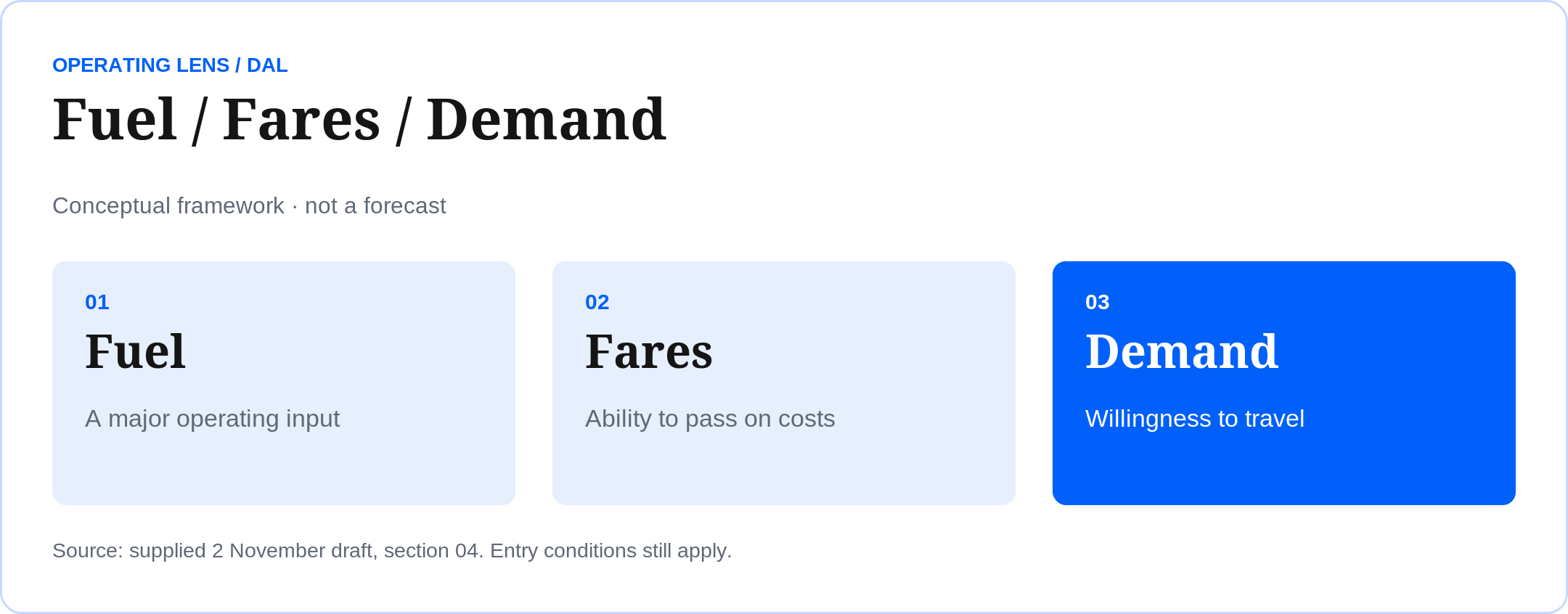
The pressure point
Delta is included as a counterpoint to the producer thesis. An airline sells journeys while paying for fuel, staff, aircraft and airport operations. When an important input gets more expensive, the question becomes how much of that change can be recovered through pricing, capacity choices and a favorable revenue mix.
A crude benchmark alone cannot establish an airline's realized fuel cost. Timing, regional fuel markets and company-specific arrangements matter. Use the company's own expense disclosures and outlook to evaluate the effect.
The key relationship is revenue earned from the available capacity against the cost of operating it. Rising sales can coexist with pressure on profit.
The investment decision
Our recommendation is to wait for evidence that fares, demand and cost control can protect cash generation before treating a fuel-driven share-price decline as a buying opportunity. A cheaper stock needs a durable earnings case.
For an existing travel allocation, compare the latest demand commentary with the price paid for the shares. For a new entry, require an outlook that can withstand both expensive fuel and a softer customer.
This is the broader lesson of the energy edition: the same macro event creates different investment conditions. The attractive purchase is the company whose cash outlook is mispriced, not simply the name receiving the most attention.
EDITORIAL VIEW
Wait for demonstrated margin resilience before a new DAL position.
Editorial analysis. Investment views are conditional on current valuation and verified disclosures.
05 / SPECTRAL CAPITAL / OTCQB: FCCN AN OPERATING BASE. |  |
An implementation opportunity built on customers, services and a long-term development strategy.
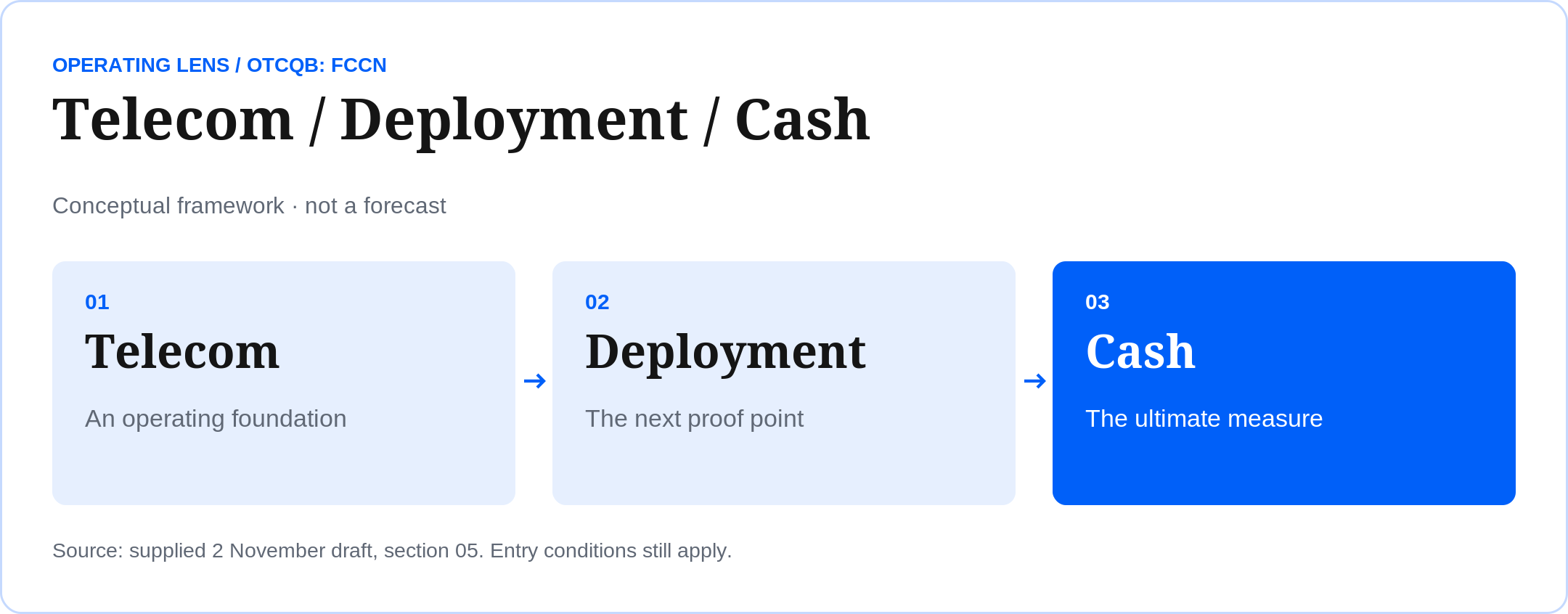
Where FCCN fits
Beyond the energy sector, efficiency creates another route to investment value. Spectral operates voice and messaging businesses through Telvantis Voice Services and 42 Telecom. That operating foundation gives its development strategy a potential commercial setting.
Our long-term opportunity thesis is to turn technology into services customers value: better execution, improved economics and opportunities to expand commercial relationships. Each successful implementation could create a stronger foundation for the next stage of growth.
The milestones to follow are funded deployment, customer adoption and measurable operating gains. As those become visible, investors can assess how much additional value the strategy may create.
Our investment recommendation
Our recommendation: consider FCCN for a small, staged long-term investment as a speculative growth opportunity. The attraction is an operating foundation combined with a technology development strategy. Review the latest financials, share structure and trading conditions before the first purchase; add as commercial execution strengthens.
The September 18 prospectus describes a Nasdaq Capital Market application. The September 28 amendment updates exhibits and does not change that prospectus. An application is not confirmation of approval.
Our constructive thesis is that an operating base creates a place to test and commercialize technology. The case becomes stronger when value reaches cash flow per share. Financing needs, dilution and execution remain part of the valuation.
FCCN
A long-term growth opportunity; invest in stages and let verified execution support conviction.
Editorial analysis. Investment views are conditional on current valuation and verified disclosures.
FCCN Sept. 18 S-1/A · FCCN Sept. 28 amendment · FCCN June 2026 Form 10-Q
06 / RESEARCH BOARD / INVESTMENT VIEWS RESEARCH THE BUSINESS. |  |
Five candidates. Clear entry conditions. A purchase price still has to be earned.
TICKER / BUSINESS · EDITORIAL VIEW · BEFORE YOU INVEST
ExxonMobil Core candidateNormalized cash supports entry. |
Chevron Core candidateCompare value with XOM. |
SLB Conditional buyActivity converts into cash. |
Delta Air Lines WaitFuel and fares support margins. |
Spectral Capital Speculative growthDeployment and financing review. |
Our preferred approach is selective accumulation in financially resilient energy businesses, with SLB as a separate cycle-sensitive candidate. Wait for airline margin evidence. Consider FCCN only as a smaller speculative allocation built around execution. Check current quotes and filings before placing an order.
Research the business. Invest with conviction.
EXPLORE YOUR TRADING PLATFORM
| Fidelity | Charles Schwab |
| Interactive Brokers | Tiger Trade |
General editorial research; entry conditions apply. Broker and ticker eligibility varies. Research cutoff: October 31, 2026.
 Research that matters. Insight you can trust. |  |
| Visit TheInvestorCall.com → |
