
THE WINTER INVESTMENT QUESTION / OCTOBER 19, 2026 CAN EUROPE |  |
| Visit TheInvestorCall.com → |
Energy infrastructure is under attack. Winter is approaching. Five stocks put Europe’s next test into investment perspective.
THE BILL ARRIVES
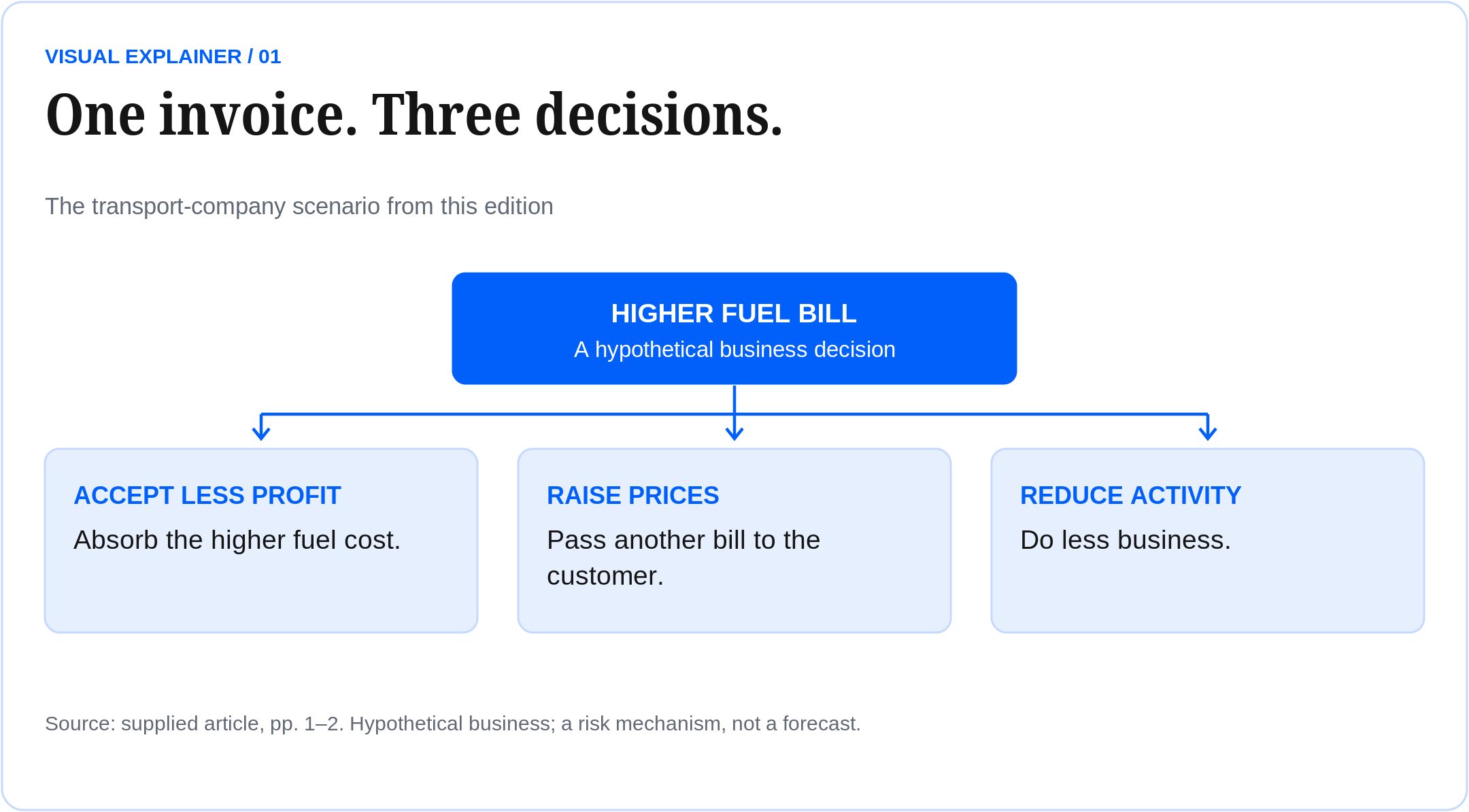
Picture a transport company in Germany on a Monday morning. The trucks are booked, the drivers have their routes, and customers have agreed on prices. Then the fuel invoice arrives. Nothing inside the business has changed. Yet the margin on every delivery has become smaller.
This hypothetical owner now faces a decision familiar across Europe: raise prices, accept less profit, or reduce activity. An energy shock travels through an economy one invoice at a time.
SUPPLY. DELIVERY. CASH FLOW.
| EQNR | SHEL | LNG | TTE | XOM |
01 / FROM CONFLICT TO COMPANY PROFITS A CHEAPER BARREL |  |
The market trades expectations. Businesses need usable fuel, delivered on time.
On October 18, Ukrainian strikes set an oil export terminal and a depot in St. Petersburg ablaze, AP reported, citing local officials. Kyiv also reported continuing Russian attacks on Ukraine’s energy facilities. These events show the exposure of physical supply infrastructure; they do not, by themselves, establish the size or duration of a global shortage.
On Monday, oil fell as the United States put new sanctions on Russia on hold, raising expectations of additional exports. Diplomacy and physical disruption were pulling expectations in different directions. A terminal fire and a lower oil price can therefore appear in the same morning’s news.
Crude oil, diesel, and natural gas are different markets. Refineries turn crude into usable fuels. Diesel then needs storage and distribution. Gas moves through pipelines or is cooled into LNG for shipment. A bottleneck in one link can leave customers paying more even when another market eases.
Return to our transport-company owner. If he absorbs higher diesel costs, profit falls. If he raises prices, his customers face another bill. Repeated across businesses, that pressure can sustain inflation, weaken spending, and leave central banks less room to lower rates. This is a risk mechanism, not a prediction that all these outcomes must occur.
The important number is the cost of delivered energy.
THREE PATHS INTO WINTER — CONDITIONAL SCENARIOS
SUPPLY IMPROVES
Deliveries recover; energy prices ease. Producer earnings may soften, while fuel buyers gain breathing room.
DISRUPTION PERSISTS
Costs remain elevated. Reliable supply and the ability to pass on expenses become more important.
DISRUPTION WORSENS
Further outages or shipping restrictions intensify pressure on margins, demand, and inflation.
Reporting: AP — October 18 energy strikes; AP — October 19 markets. Analysis and scenarios: The Investor Call.
02 / THE NEARBY SUPPLIER AND THE GLOBAL NETWORK FIRST, LOOK NORTH. |  |
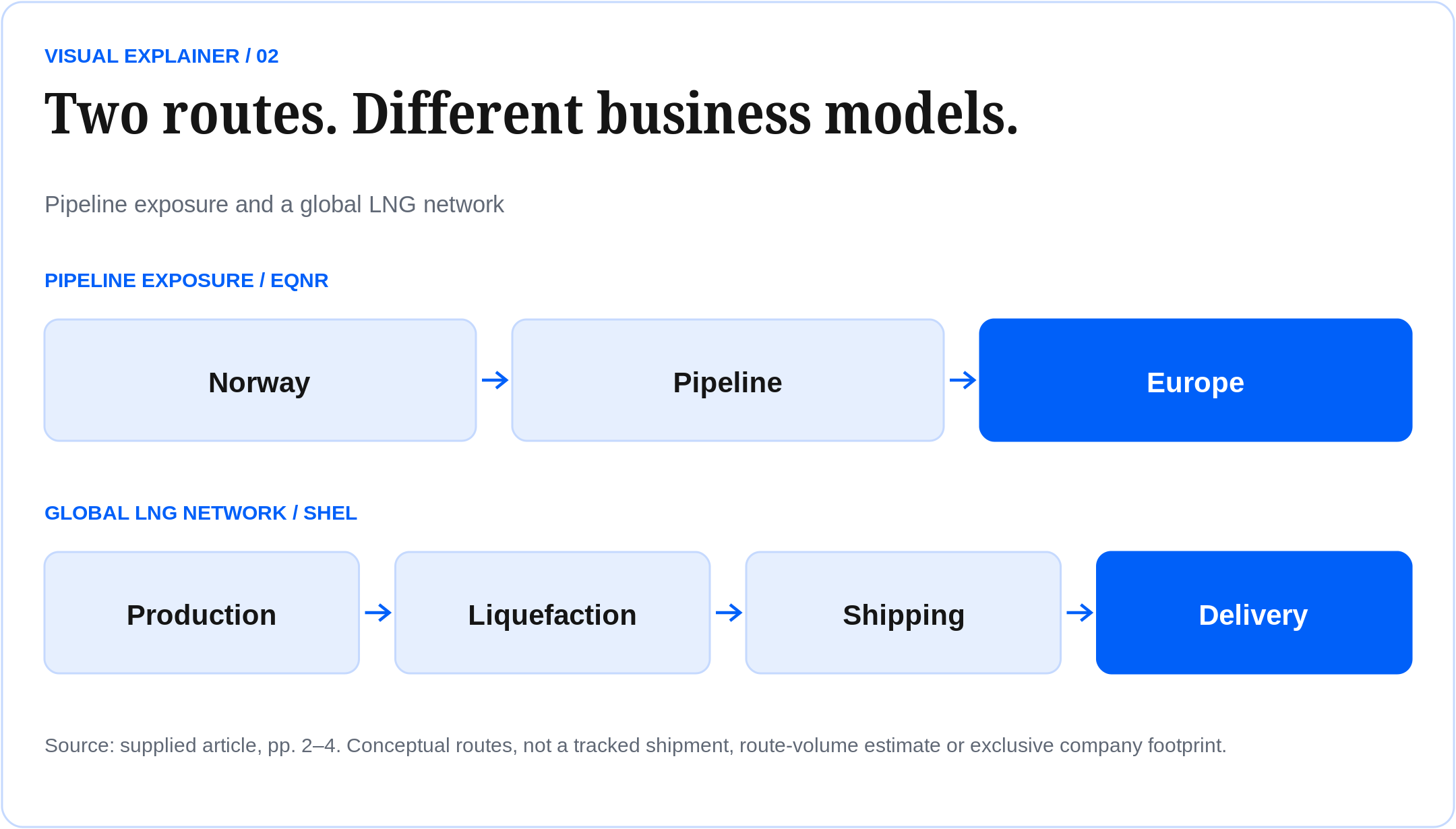
Equinor and Shell connect Europe to energy through different business models.
NYSE: EQNR
Equinor: the pipeline connection
Norway gives Europe a nearby source of gas with established delivery infrastructure. Equinor identifies itself as Europe’s largest supplier of pipeline gas. That places the company directly inside the continent’s energy-security system.
Our investment thesis: dependable production could support earnings when alternative supply is uncertain. Elevated realized gas prices can help cash generation if volumes remain reliable. But weather, industrial demand, additional imports, and operational outages can change the outcome.
The test: examine production, realized gas prices, and cash remaining after investment and taxes. Stress-test distributions at lower gas prices. A prominent supply role does not prove that the shares are inexpensive.
NYSE: SHEL
Shell: the network behind the cargo
When pipelines cannot supply enough, buyers can turn to LNG cargoes. Shell participates across the chain, including production, liquefaction, trading, shipping, and delivery. Its network offers several ways to serve customers as trade routes shift.
Our interpretation: sourcing flexibility and delivery capability can have commercial value during disruption. Yet volatility does not guarantee trading profits. Contracts, hedging, freight costs, and operating performance determine how much value reaches shareholders.
The test: follow Integrated Gas performance alongside group cash flow, investment spending, and distribution coverage. Shell’s wider oil, refining, and chemicals activities also influence earnings. Compare the valuation with a normal energy environment, rather than only a crisis quarter.
Company disclosures: Equinor — natural gas; Shell — LNG operations. Investment interpretation: The Investor Call.
| Visit TheInvestorCall.com → |
03 / THE CONTRACT BEHIND THE CARGO BEFORE GAS |  |
Cheniere puts export capacity and long-term commercial agreements at the center of the case.
NYSE: LNG
Cheniere Energy
Imagine an illustrative cargo leaving the U.S. Gulf Coast for a European receiving terminal. Before loading, natural gas is cooled into liquid so it occupies far less space. At its destination, the LNG is converted back into gas for use. This describes a possible journey, not a specific tracked shipment.
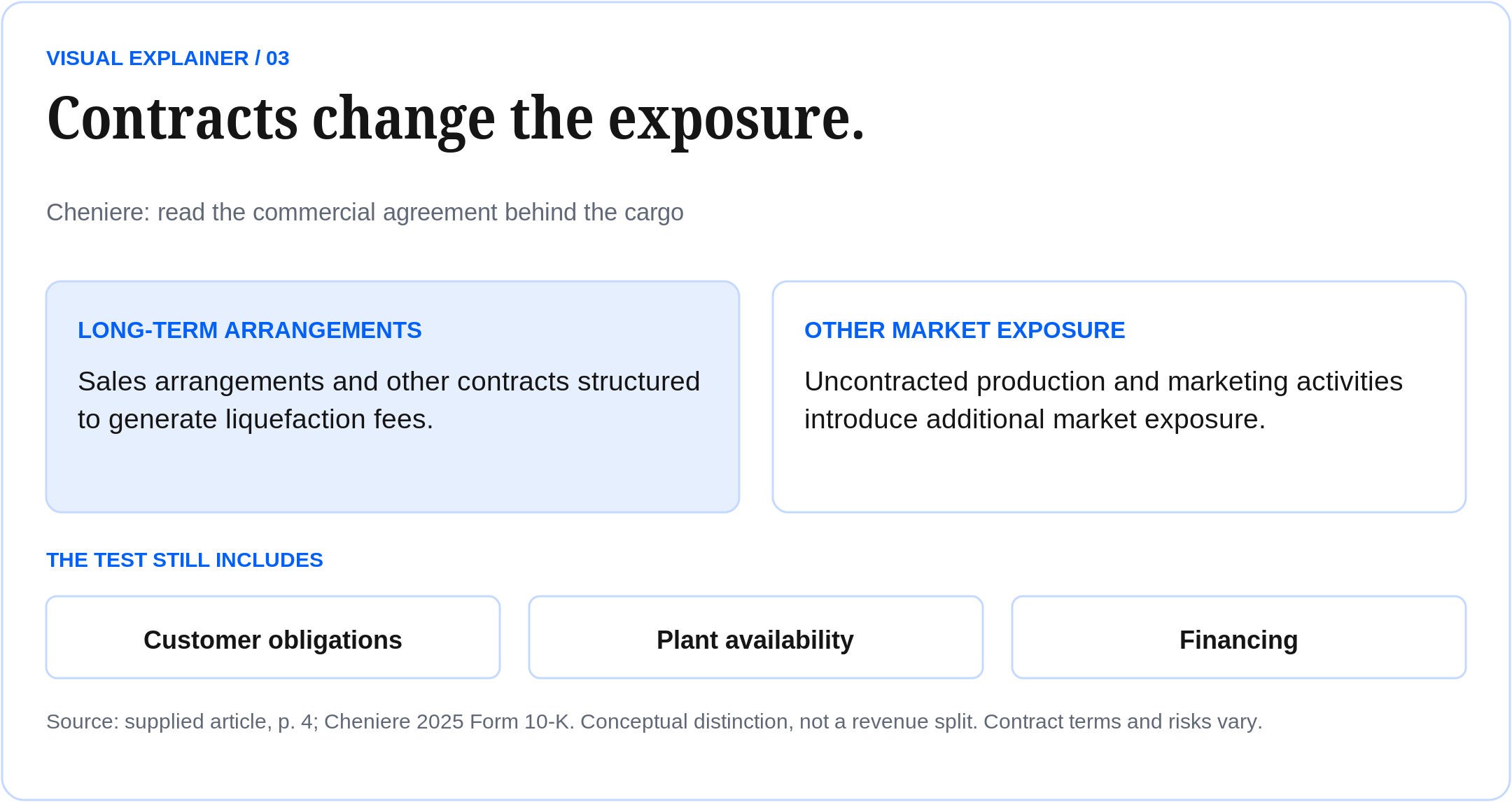
Cheniere operates the liquefaction infrastructure on the American side of that journey. Its filings describe long-term sales arrangements and other contracts structured to generate liquefaction fees. Uncontracted production and marketing activities introduce additional market exposure.
An investment in export capacity has different economics from a bet on tomorrow’s gas price.
That distinction is essential. Higher European gas prices do not translate proportionately into higher Cheniere earnings. Contract terms determine much of the revenue. Long-term arrangements can improve visibility, while customer obligations, plant availability, and financing still matter.
Our investment thesis is that dependable export capacity can retain commercial value beyond a single winter. Buyers seeking diverse supply may commit for years. Shareholders must still judge whether the cash generated justifies the construction and financing costs.
The test: monitor operating availability, contracted volumes, expansion spending, debt, and cash flow. A well-contracted project can disappoint if it costs too much to build or fails to operate as expected. Additional global LNG capacity can also change future contracting economics.
Primary source: Cheniere Energy — 2025 Form 10-K. Contract features vary; see current filings for full terms and risks.
04 / BEYOND A SINGLE COMMODITY BET THE BROADER |  |
TotalEnergies and ExxonMobil connect production with other parts of the energy economy.
NYSE: TTE
TotalEnergies: several earnings engines
TotalEnergies combines oil and gas with electricity and other energy activities. Its LNG position adds another route through which the company can participate in the need for dependable international supply.
Our thesis: a broader portfolio offers several potential sources of earnings, rather than dependence on one local gas market. Investors must nevertheless examine where the assets are located, how contracts work, and whether capital spending earns adequate returns.
The test: compare LNG performance and group cash generation with investment needs and shareholder distributions. Lower commodity prices, outages, project delays, and poorly rewarded expansion can weaken the case. Diversification is useful only if the underlying economics hold up.
NYSE: XOM
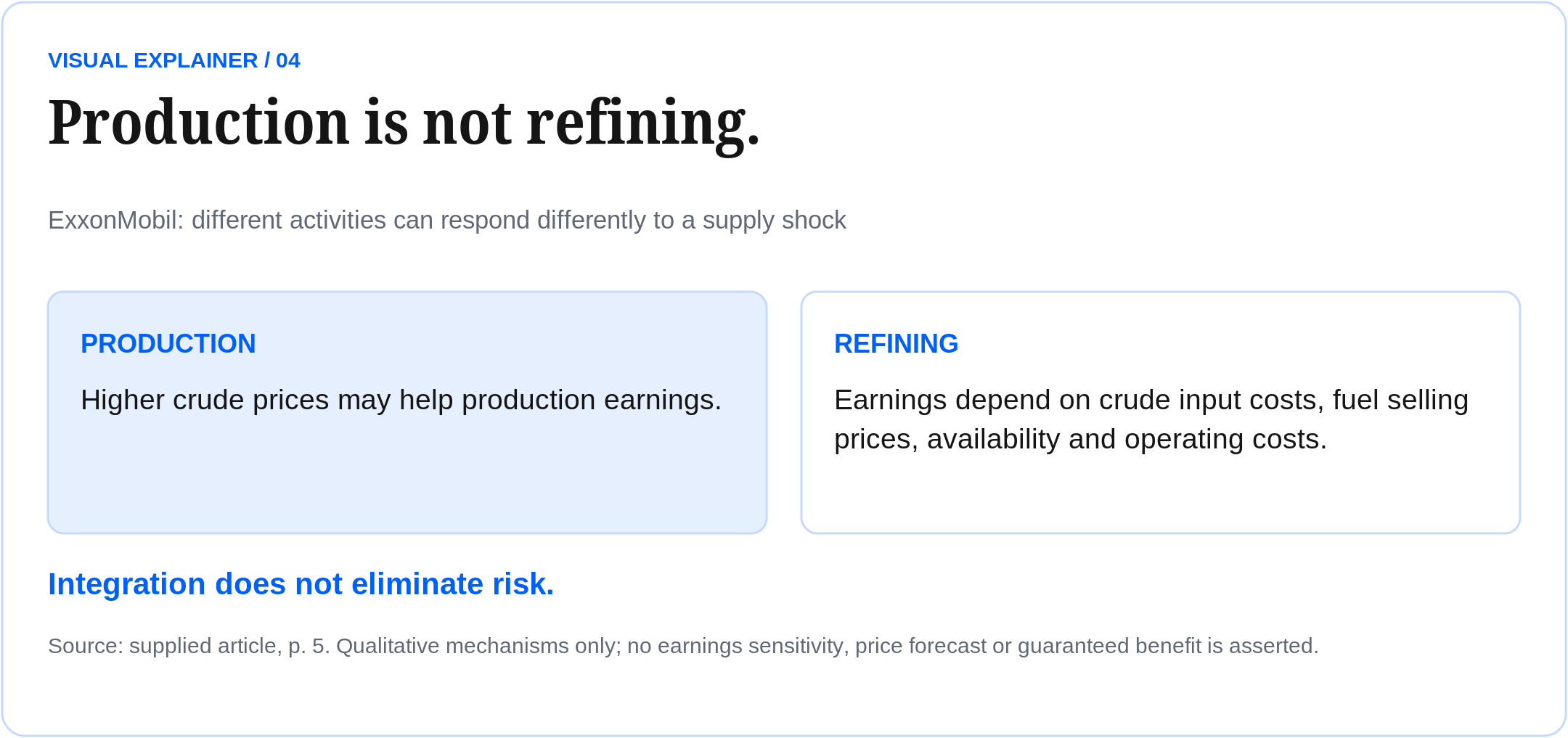
ExxonMobil: production meets refining
ExxonMobil’s integrated model includes oil and gas production, refining, logistics, and marketing. Its filings also identify the Permian, Guyana, and LNG among its important growth areas.
A supply shock can affect these activities differently. Higher crude prices may help production earnings. Refining depends on the relationship between crude costs and fuel selling prices, as well as availability and operating costs. Integration provides multiple exposures; it does not eliminate risk.
The test: examine production costs, project delivery, refining performance, and free cash flow. Stress-test dividend coverage and spending plans at lower oil prices. The investment case should stand on operating economics as well as the current geopolitical backdrop.
Primary sources: TotalEnergies — company and investor disclosures; ExxonMobil — 2026 second-quarter filing.
05 / FROM THE STORY TO THE INVESTMENT DECISION FIVE STOCKS. |  |
A research watchlist for the next energy shock—not a claim that every share is cheap today.
EQNR Equinor — Pipeline-gas exposure
Risk: Lower gas prices or lost volumes. Watch: Realized gas prices and production.
SHEL Shell — Global supply and LNG network
Risk: Weak margins or operational disruption. Watch: Integrated Gas earnings and cash flow.
LNG Cheniere Energy — Contracted export capacity
Risk: Expansion costs, debt, or outages. Watch: Capital spending and contracted cash flow.
TTE TotalEnergies — Broader oil, LNG, and power portfolio
Risk: Commodity weakness or project setbacks. Watch: Cash flow after investment.
XOM ExxonMobil — Production and refining economics
Risk: Lower crude prices or refining margins. Watch: Free cash flow and project delivery.
If supply improves, lower prices may relieve energy buyers while reducing producer earnings. If disruption persists, delivery reliability and contract quality deserve closer attention. Across both outcomes, compare debt, cash flow, and valuation under less favorable assumptions.
Back at our transport company, the next invoice still matters. For investors, the task is to find businesses that can keep delivering—and buy their future earnings at a sensible price.
RESEARCH AND TRADING PLATFORMS
| Fidelity | Charles Schwab |
| Interactive Brokers | Tiger Brokers / Tiger Trade |
Availability, eligibility, fees, and supported securities depend on the broker and your jurisdiction.
| Subscribe now for free | Get in touch with our team |
For informational purposes only; not personalized investment advice. Research dated October 19, 2026. No live prices or valuation-based buy ratings are presented.
 Research that matters. Performance you can measure. Insight you can trust. |  |
| Visit TheInvestorCall.com → |
