
|
MARKETS / THE LONG POSITION / OCTOBER 15, 2026 AI IS MAKING MONEY. |  |
Research the business. Invest with conviction. Give long-term value time to develop.
The earnings are real. The market is still asking what comes next.
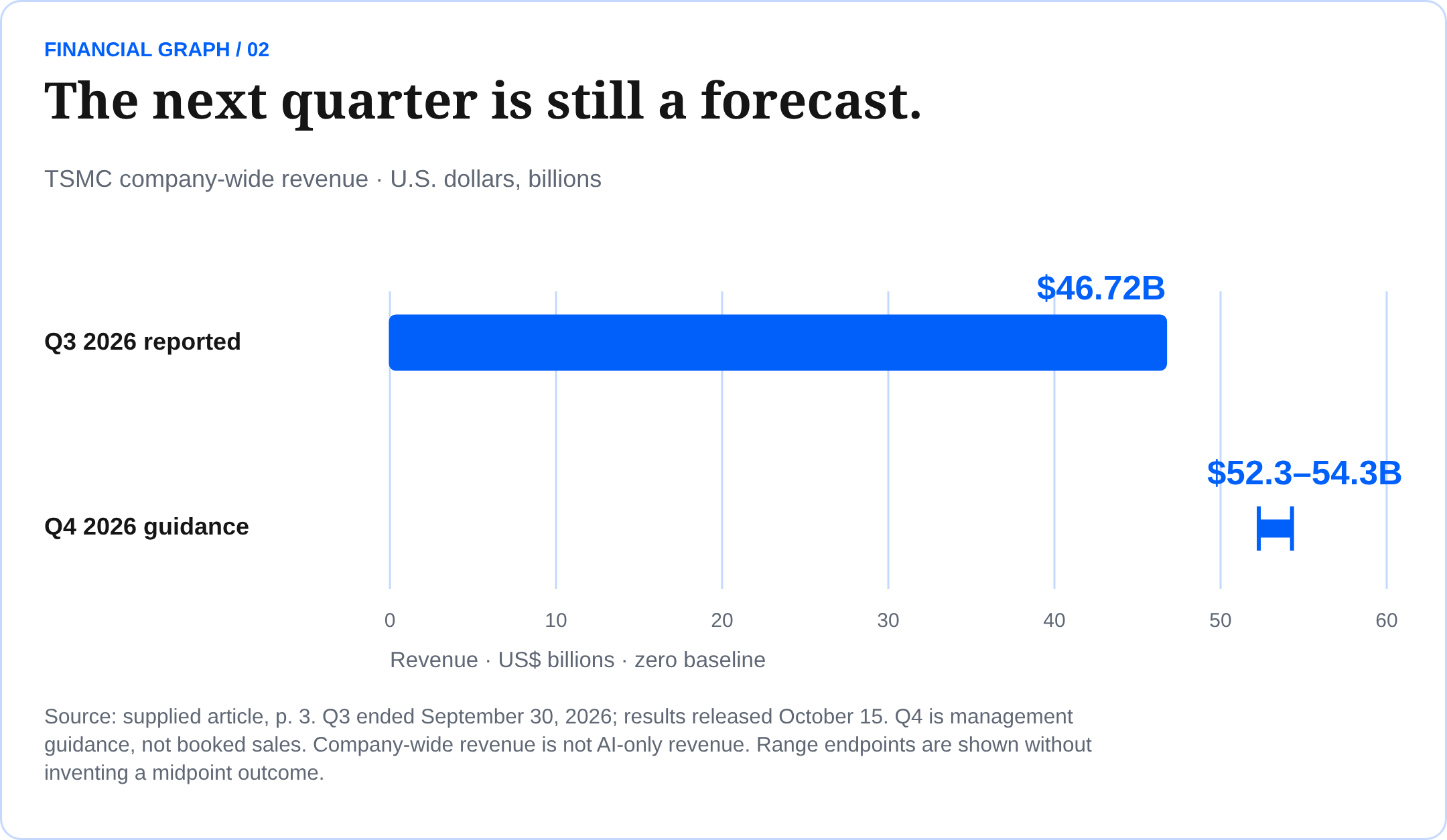
On October 15, TSMC reported $46.72 billion in third-quarter revenue and a 66.4% gross margin. Its fourth-quarter sales forecast points higher again. The business evidence is substantial. The market mood is more complicated.
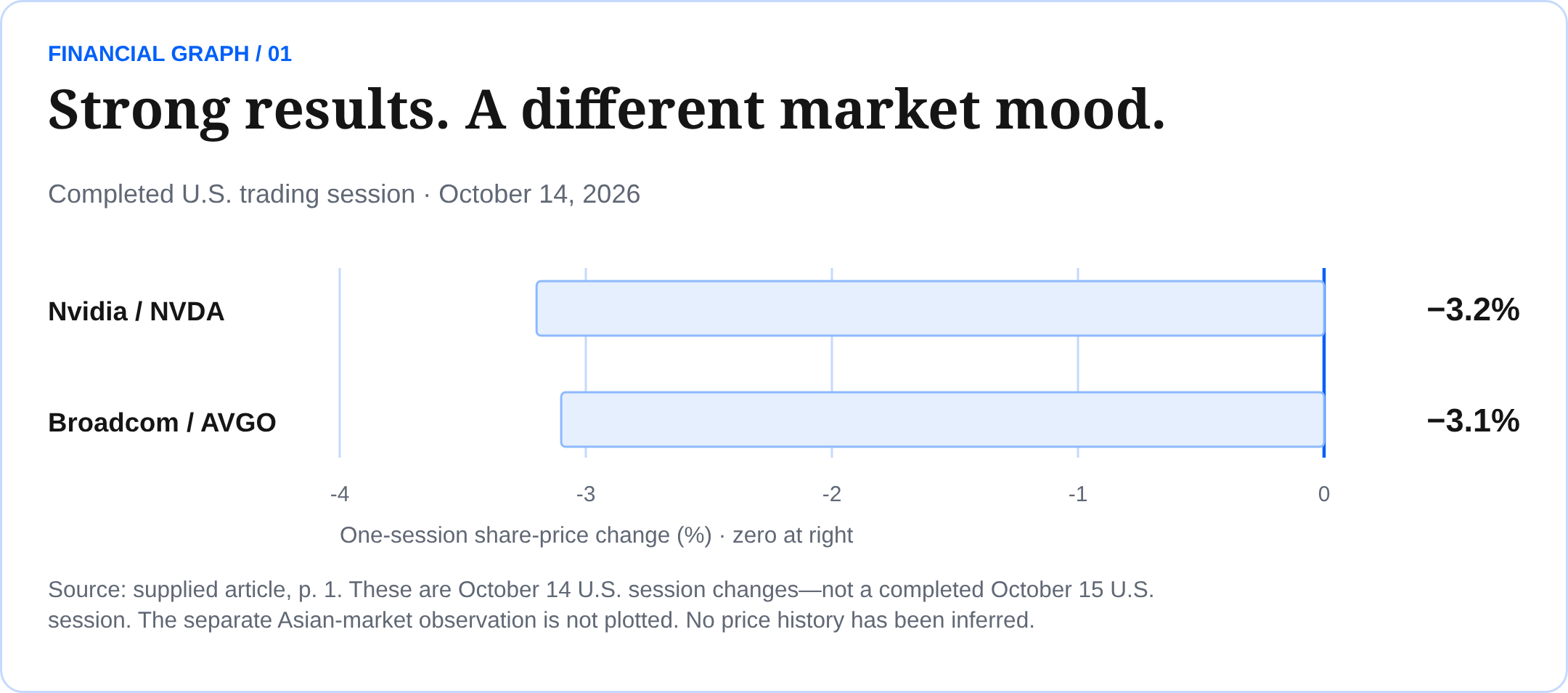
Asian technology shares fell sharply on Thursday. In the completed U.S. session on October 14, Nvidia declined 3.2% and Broadcom fell 3.1%. These moves belong to different trading sessions; they are not a report of a completed October 15 U.S. session.
$46.72B TSMC Q3 2026 REVENUE Reported October 15 | 66.4% TSMC Q3 GROSS MARGIN Company-wide results |
A share price represents what investors are prepared to pay for future earnings. Strong results can arrive alongside changing expectations, higher required returns or a reassessment of the price paid for growth. That makes the gap between business performance and market sentiment worth investigating.
For a long-term investor, the useful response is a better question: what would make this business more valuable over several years, and how much of that progress is already reflected in its price?
This edition follows four businesses at different points in that journey: TSMC, Nvidia, Broadcom and Spectral Capital. The objective is to turn an attractive theme into a researched ownership decision.
Research first. Invest with discipline. Hold while the evidence supports the case.
Market observations: Asia on October 15 and completed U.S. trading on October 14. Research cutoff: October 15, 13:50 EEST.
01 / THE INVESTOR TOOLKIT / OWNERSHIP RESEARCH. |  |
A long position starts with a purchase. A durable investment case starts with understanding.
Taking a long position means buying shares with the expectation that they may appreciate. Choosing a long holding period is a separate decision: it gives a business time to develop, but the passage of time does not replace evidence.
Begin with the economics
Understand who pays the company, why customers keep buying and what remains after the costs of delivering its product. Follow earnings into operating cash flow. Then examine how management reinvests that cash, funds acquisitions or returns capital to shareholders.
The purchase price belongs in that research. A company can deliver excellent growth while its shares deliver a different result because the starting valuation assumed even more.
HYPOTHETICAL EXAMPLE | AT PURCHASE | LATER |
|---|---|---|
Earnings per share | $10 | $12 |
Price / earnings multiple | 40 times | 30 times |
Implied share price | $400 | $360 |
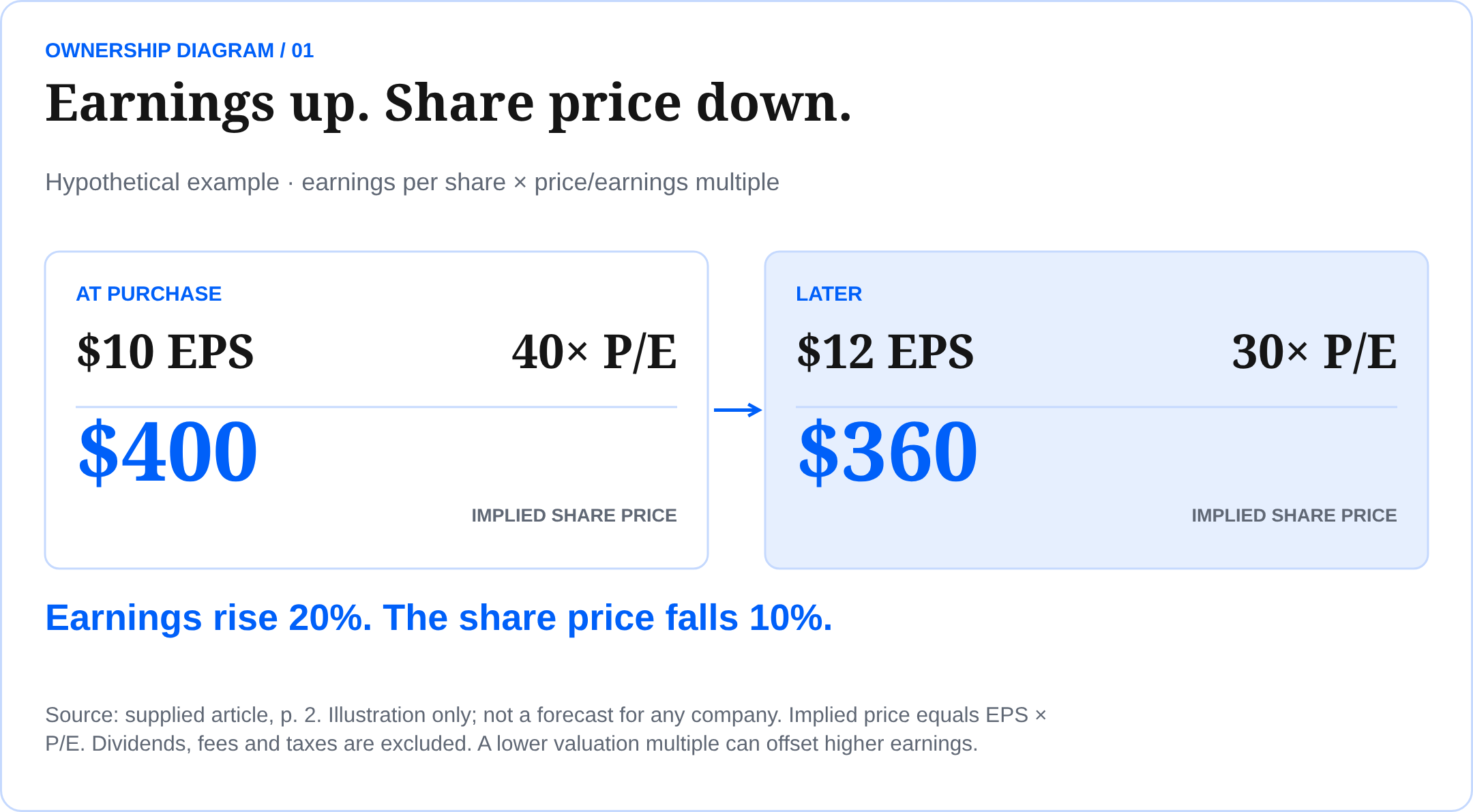
Earnings rise 20%. The share price falls 10%.
This illustration excludes dividends, fees and taxes. The calculation is simple: earnings per share multiplied by the valuation multiple. A smaller multiple can offset rising earnings. Valuation is part of the ownership case at the beginning and throughout the holding period.
Give conviction a review process
Write down what must happen for the investment to work. Choose a position size that fits the strength of the evidence and your overall portfolio. Building gradually can spread purchase dates. Review each quarter against the same business milestones rather than letting every market move rewrite the plan.
Patience becomes useful when it is attached to a business that keeps delivering.
Continue holding while the facts support ownership; revisit the decision when those facts change.
The valuation example is hypothetical and is not a forecast for any company. Long position and long holding period are separate concepts.
02 / TSMC / NYSE: TSM THE MANUFACTURING |  |
A long-term investment case built around advanced production, customer demand and profitable expansion.
$46.72B Q3 2026 REVENUE +41.2% in U.S. dollars | 58.7% Q3 OPERATING MARGIN Company-wide | $52.3–54.3B Q4 REVENUE GUIDANCE Management forecast |
The reported evidence
TSMC manufactures chips designed by its customers. Its October 15 report showed third-quarter revenue of NT$1,494.24 billion and net income of NT$763.06 billion. Revenue rose 50.9% in Taiwan dollars and 41.2% in U.S. dollars; net income increased 68.7%. Currency translation explains why the two revenue growth rates differ.
Advanced processes, defined by TSMC as 7 nanometers and below, represented 79% of wafer revenue. The new 2-nanometer process contributed 8%. Management expects continued demand for advanced technologies to support the fourth quarter, with a gross margin forecast of 65%–67%. These are company-wide figures, not a disclosure that all sales come from AI.
Our long-term interpretation
The investment attraction is the ability to translate difficult manufacturing work into recurring customer demand and earnings. Technology leadership has economic value when customers need the performance, production yields and delivery capacity it enables.
For an owner, the important relationship is between expansion and the returns it produces. New capacity becomes valuable when it fills with profitable work. A research case should therefore connect spending to future utilization, customer commitments and the earnings available to shareholders.
What would support continued holding?
Track delivery against quarterly guidance, adoption of advanced manufacturing, operating margins and the cash left after investment. Compare that progress with the valuation at which the shares can be purchased. Strong operating execution and an appropriate entry price are complementary parts of the case.
TSMC: quarter ended September 30, 2026; results released October 15. Q4 figures are management guidance, not completed results.
|
03 / NVIDIA + BROADCOM / NASDAQ: NVDA + AVGO TWO ENGINES OF |  |
Computing platforms, custom silicon and networking offer distinct ways to study the same infrastructure cycle.
Nvidia: the computing platform
Nvidia combines processors, networking and software to support AI computing. In fiscal Q2 2027, ended July 26, 2026, revenue reached $96.2 billion, up 106% year over year. Data Center revenue was $89.0 billion. GAAP net income was $59.7 billion and gross margin was 75%.
Its August 26 outlook called for $108 billion in fiscal Q3 revenue, plus or minus 2%, and a 74% gross margin, plus or minus 0.5 percentage point. Those figures are forecasts. Our ownership thesis centers on customers continuing to deploy useful computing at scale, with the platform converting demand into earnings and cash.
Broadcom: specialized chips and connections
Broadcom supplies custom AI accelerators and networking, alongside infrastructure software. Accelerators perform specialized computing work; networking moves information between systems. Fiscal Q3 2026, ended August 2, produced $29.6 billion in revenue, $16.7 billion in AI semiconductor revenue and $13.7 billion in company-defined free cash flow.
In its September 2 release, management forecast approximately $34.8 billion in total fiscal Q4 revenue and $21.7 billion in AI semiconductor revenue. Our interpretation is that custom silicon can create value when large computing programs become repeat business, while cash generation gives management resources to reinvest and return capital.
OWNERSHIP LENS | NVIDIA | BROADCOM |
|---|---|---|
Business model | AI computing platform | Custom chips, networking and software |
Growth to monitor | Deployments and platform adoption | Custom AI programs and network demand |
Cash discipline | Earnings conversion after working capital and investment | Free cash flow after investment and shareholder distributions |
Research them separately. Understand their shared exposure.
Both depend in part on continued AI infrastructure investment. Holding both adds business-model variety, but it does not remove dependence on that spending cycle. Review customer demand, profitability and valuation company by company.
Nvidia: fiscal Q2 2027, released August 26, 2026. Broadcom: fiscal Q3 2026, released September 2. Forecasts retain their original dates.
04 / SPECTRAL CAPITAL / OTCQB: FCCN THE NEXT STAGE |  |
From acquired telecommunications scale to the operating progress that could support long-term value.
Start with what operates today
Spectral Capital operates international voice and messaging businesses through Telvantis Voice Services and 42 Telecom. Its operating base connects the story to digital infrastructure. Its plans for AI-enabled software, intellectual property and expansion are a further stage to evaluate, rather than a reason to relabel existing telecom sales as AI revenue.
$318.3M Q2 2026 REVENUE Consolidated, unaudited | $3.3M Q2 GROSS PROFIT Up from $2.2M in Q1 | $646.8M H1 2026 REVENUE Consolidated, unaudited |
Read the financial bridge
The August 12 results release reported a Q2 operating loss of approximately $1.9 million, narrowed from $3.0 million in Q1. Reported Q2 net income included a $9.9 million noncash gain from remeasuring acquisition-related contingent consideration. That gain does not represent cash generated by customer activity.
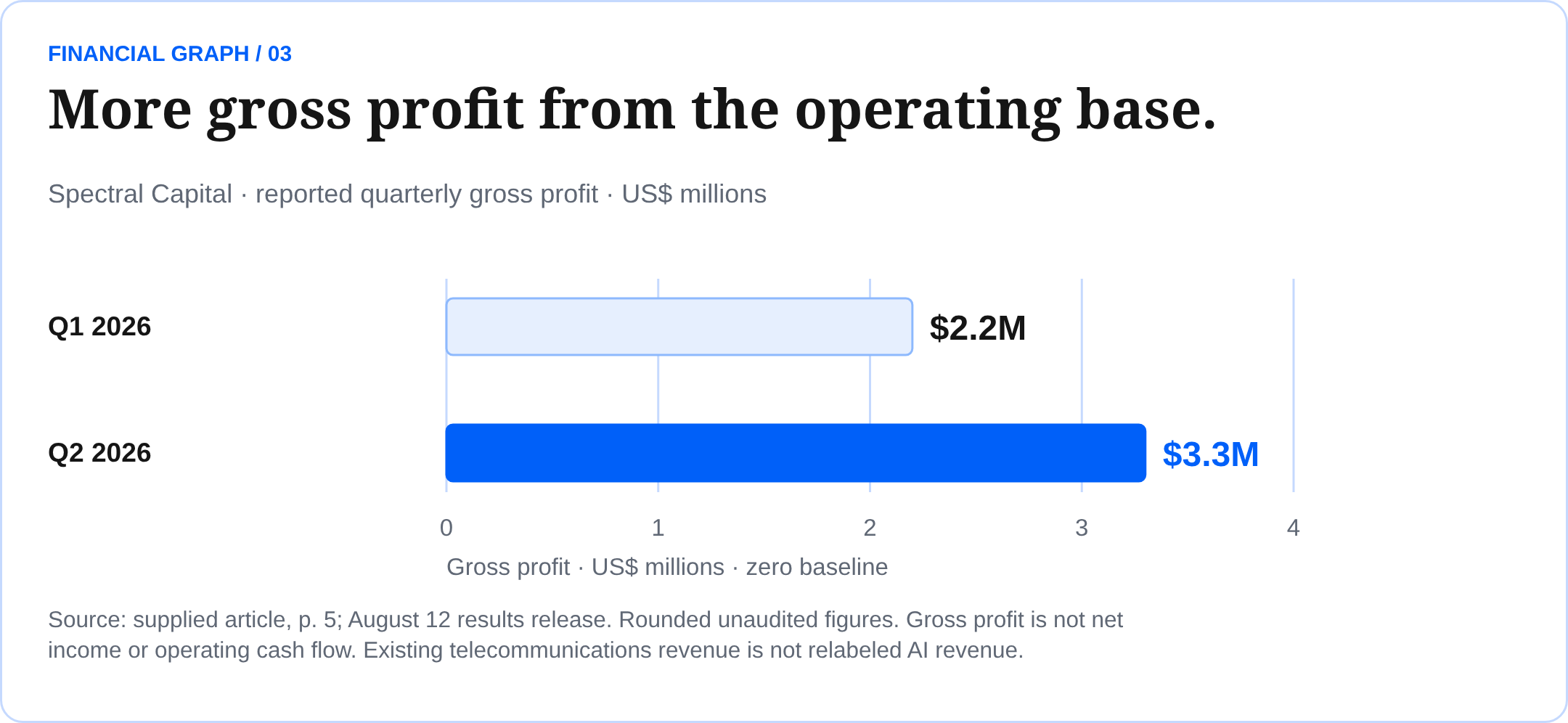
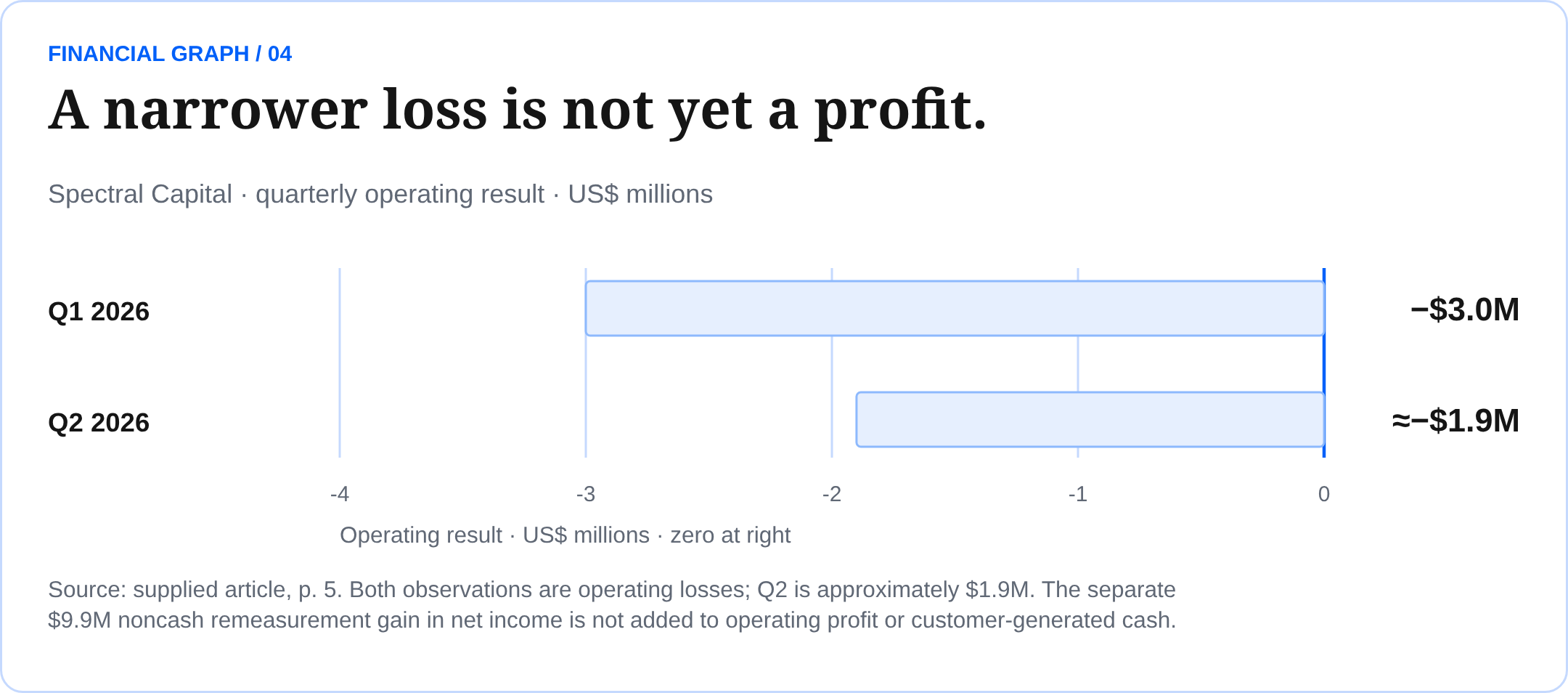
Management aims to improve the acquired businesses through integration, software and commercial execution. The research opportunity is to examine whether that strategy produces a steadily better relationship between revenue, gross profit and cash collection.
Our long-term research case
Scale gives management a larger operating base on which to work. The investment case becomes stronger if improved routing, better customer economics and shared capabilities translate into durable operating cash flow. Progress should ultimately be visible per share, after considering financing and acquisition consideration.
FCCN is quoted on OTCQB. The company has described a proposed Nasdaq Capital Market listing; the reviewed materials do not establish completion. Assess business delivery on its own merits while treating a proposed listing as a separate corporate milestone.
What would support patient ownership?
Track gross margins, integration, operating cash generation and capital allocation. Spectral is at a different stage from the semiconductor companies; assess its valuation, position size and execution separately.
Spectral: unaudited Q2 and H1 results through June 30, 2026; August 12 release and September 18/28 SEC amendments. No live share price used.
05 / THE OWNERSHIP PLAN / FOUR COMPANIES TURN RESEARCH |  |
A useful investment thesis tells you what to buy, what to pay and what would justify staying invested.
COMPANY | WHY RESEARCH IT | LONG-TERM DRIVER | EVIDENCE TO HOLD |
|---|---|---|---|
TSMC / TSM | Advanced chip manufacturing | Profitable production expansion | Demand, margins and investment returns |
Nvidia / NVDA | AI computing ecosystem | Platform deployment and adoption | Customer spending, earnings and cash |
Broadcom / AVGO | Custom silicon and networking | Repeat AI programs and cash generation | Delivery, demand and free cash flow |
Spectral / FCCN | Acquired infrastructure platform | Integration and operating improvement | Margins, cash conversion and per-share value |
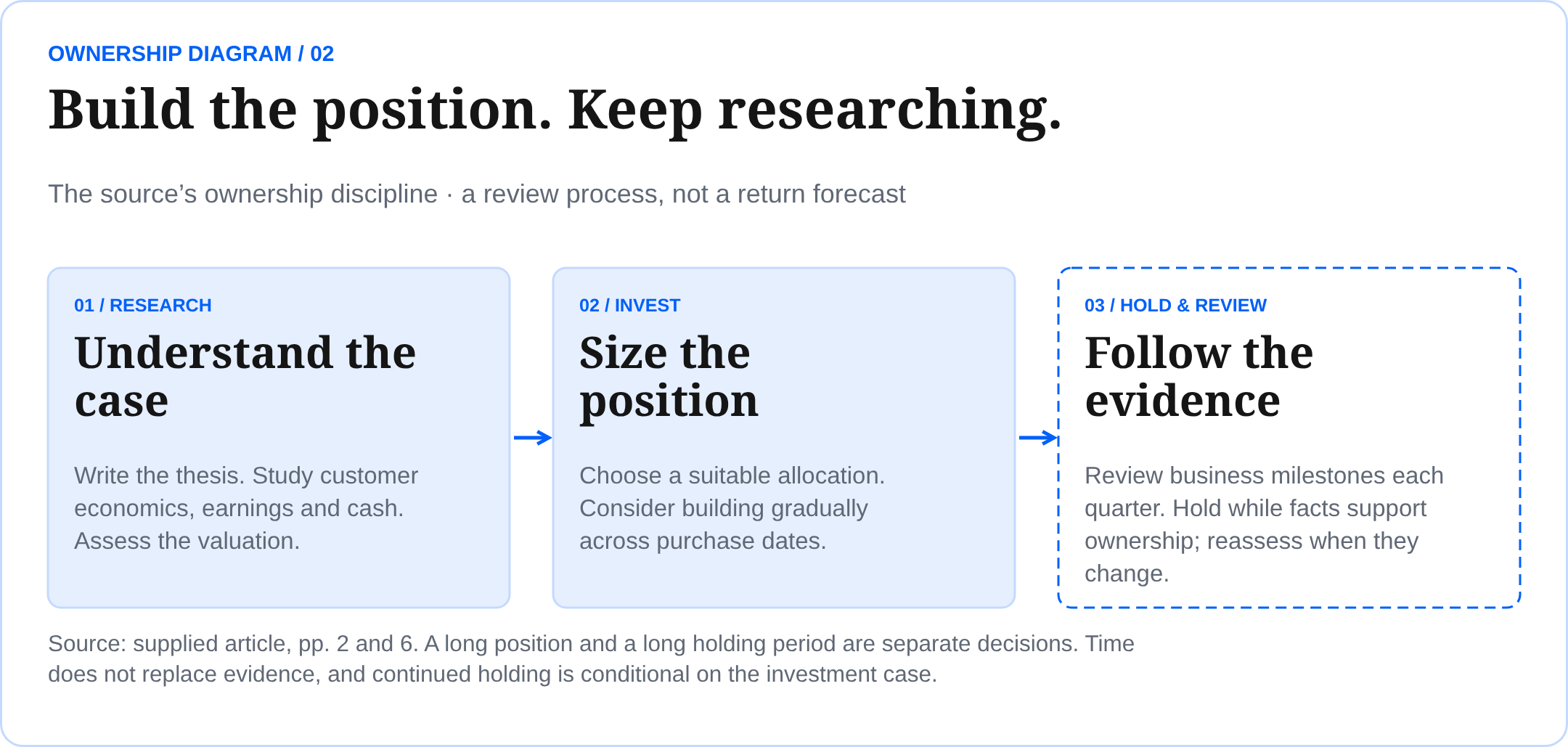
Build the position. Keep the research active.
Write the ownership thesis and assess the valuation before buying. Choose a suitable position size and consider entering in stages. Review revenue quality, earnings, cash flow and management delivery each quarter. Hold while the evidence supports the case; reassess when the facts change.
Continue the research with us
Follow the business behind the ticker with The Investor Call. Continue the research and bring your questions to our team.
www.theinvestorcall.com | Get in touch with our team
| FIDELITY | CHARLES SCHWAB | |
| INTERACTIVE BROKERS | TIGER TRADE / TIGER BROKERS | |
Security availability, including FCCN, depends on your country, account permissions and broker.
| Subscribe now for free | Get in touch with our team |
Editorial research for general information; not personalized investment advice. Broker links lead to official sites and are not ticker-availability confirmations.
 Research that matters. Performance you can measure. |  |
Production note: presentation adapted from the supplied October 15, 2026 article. Narrative figures, forecasts, session dates and qualifications are preserved. Charts visualize source data only; figures and company-status claims have not been independently verified or updated.
|
